




Seven in 10 Filipinos are still on handsets that only connect to 3G, putting local telcos under pressure to move millions of subscribers to 4G and 5G before the National Telecommunications Commission (NTC) pulls the plug on 3G networks by December 31, 2026.
That’s the picture from a new network performance study by Ookla, the global network intelligence firm behind Speedtest. The study ran across Metro Manila between February 17 and 22, 2026, covering more than 1,200 kilometers of drive testing across 14 cities and municipalities, with researchers collecting over 23,000 voice and data samples using Samsung flagship smartphones.
Where the Philippines stands
The Philippines remains one of the slowest countries in the world on Voice over LTE (VoLTE) migration, with a 30.9-percent penetration rate recorded in 2025. VoLTE is the next-generation mobile voice standard that replaces 3G calls. The NTC has ordered all telcos to complete the 3G shutdown by year-end, which means the gap still to be closed is steep: at least 69 percent of Filipinos have yet to connect to VoLTE.
The Philippines trails its Southeast Asian neighbors by a wide margin. Malaysia has reached a VoLTE rate of 96.1 percent, Singapore sits at 94.9 percent, and Thailand is at 65.2 percent. The global average is 57.7 percent.
Ookla traces part of the delay to a late start. Smart Communications rolled out VoLTE nationally only in 2020, with Globe following the year after – years behind the regional pace.
Globe and Smart lag behind DITO
Among the three telco operators, DITO Telecommunity posted the highest VoLTE rate at 41.9 percent. Ookla attributed this to DITO’s requirement to build a standalone 5G network as a condition of entering the telco market. Smart’s VoLTE rate reached 31.7 percent, while Globe came in lowest at 27.4 percent.
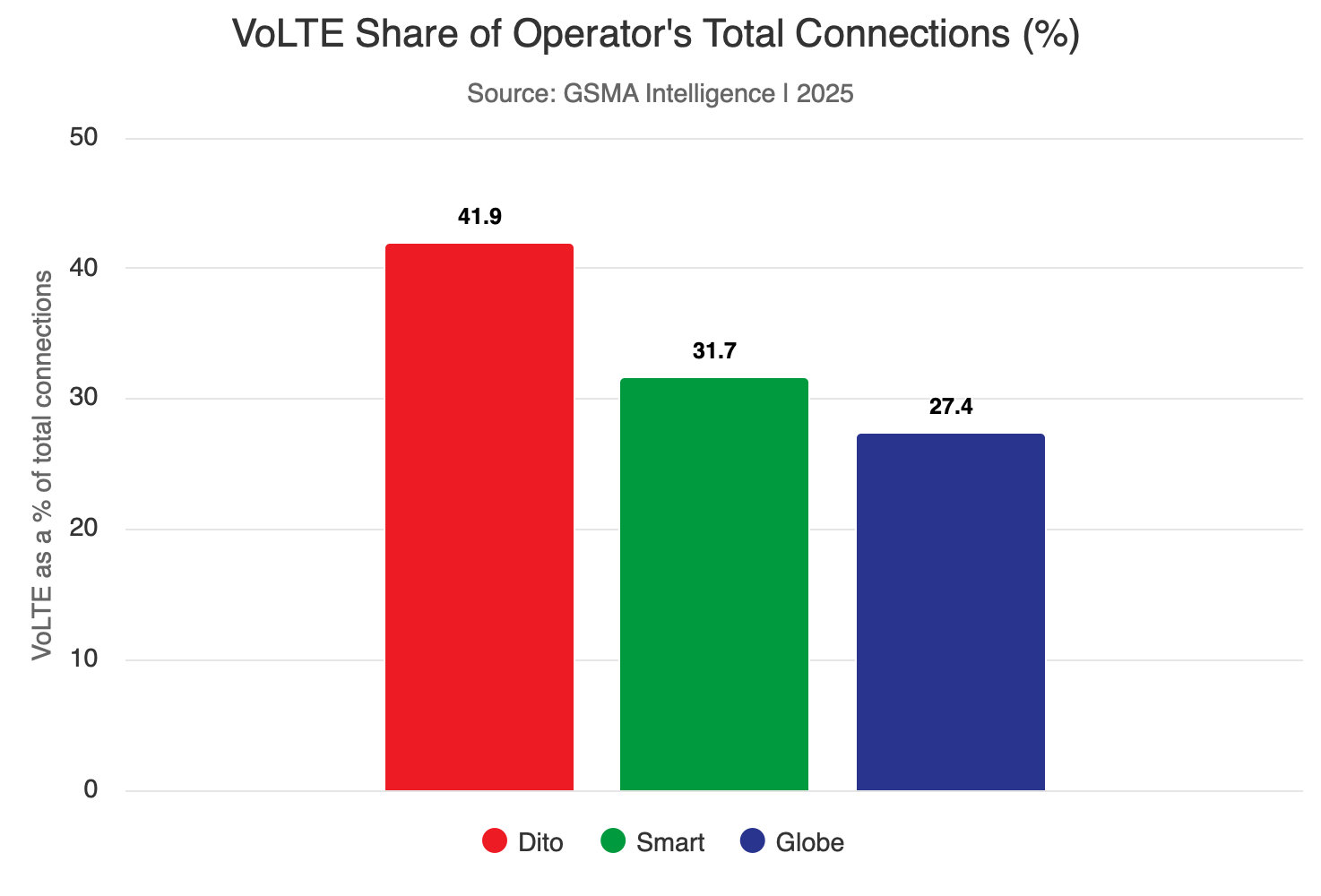
Ookla noted the structural reason for the gap between DITO and the two incumbents. “In contrast, Smart and Globe manage massive subscriber bases that still include users with older devices,” Ookla said. “While both operators process nearly all of their active 4G voice traffic through a mature VoLTE architecture, migrating the remaining legacy 3G devices ahead of the 2026 NTC deadline would depend on regulatory support, since consumers’ device upgrades are constrained by affordability and cannot be driven by operators alone,” Ookla added.
Call quality holds up – for now
Despite the migration gap, Ookla found that voice call quality across all three operators was solid where VoLTE was active. Using Mean Opinion Score testing on a scale of 1 to 5, mobile-to-mobile calls consistently delivered Good to Excellent ratings above 4.0 across Globe, Smart, and DITO.
Globe delivered the fastest median VoLTE call setup time at 1.65 seconds, followed by Smart at 2.30 seconds. DITO recorded a median setup time of 4.59 seconds, a result of its reliance on Evolved Packet System Fallback within its 5G Standalone network architecture.
There’s a gap on reliability too. VoLTE block rates were 0.47 percent for Globe, 0.59 percent for Smart, and 0.73 percent for DITO. OTT voice apps like WhatsApp had significantly higher block rates – 1.64 percent on Globe, 2.33 percent on DITO, and 2.76 percent on Smart.
What comes next
For subscribers still on older phones, the clock is ticking. Once 3G goes dark at year-end, devices without 4G or 5G capability will lose mobile voice and data entirely – they won’t be able to call, text via the carrier network, or browse. Upgrading to a 4G-capable handset is the only way to stay connected.
GSMA Intelligence forecasts Philippine VoLTE adoption will exceed 50 percent in 2027 and reach 70.4 percent by 2030 – projections that assume the 3G shutdown proceeds as ordered and subscribers move off legacy devices. Whether that happens on schedule depends partly on how much device upgrade support the NTC and telcos can offer before December.