



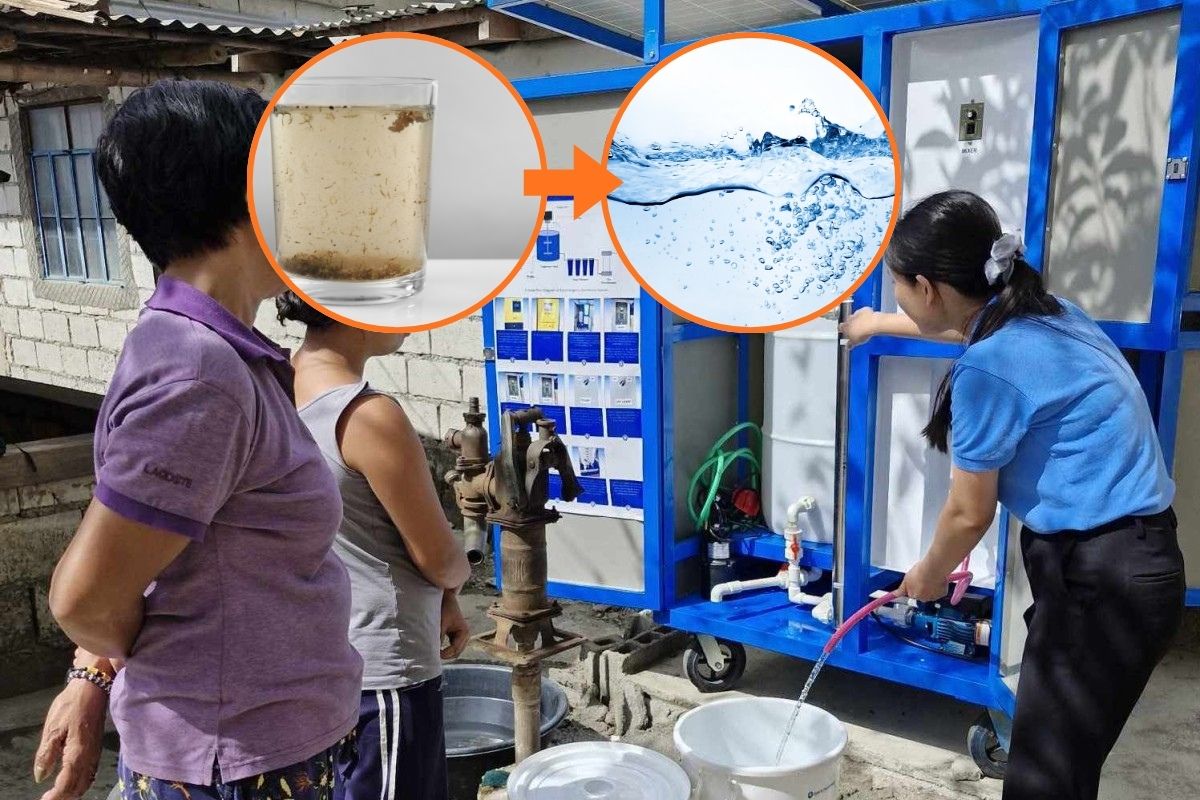
In Sitio Socorro, a small settlement tucked into Barangay Moriones in San Jose, Tarlac, clean water used to mean a long walk, a waiting game, or whatever could be scooped from any source that comes up. For the Abelling tribe who live there, that changed on January 30, 2024, when a blue steel cabinet on wheels arrived, powered by nothing but the sun.
The machine is called SAFEWTRS, short for Safe Water Treatment System: Emergency Disinfection System of Drinking Water. Built by the Department of Science and Technology’s Industrial Technology Development Institute (DOST-ITDI), it looks almost unremarkable from the outside – a boxy blue frame with solar panels, a battery bank, and a set of taps.
What it does is not unremarkable at all: it takes water that would otherwise be unsafe to drink, whether from rain, a spring, a turbid stream, or even saltwater, and turns it into something a family can drink without worrying about contracting diseases. At full run, it produces up to 2,000 liters in nine hours. At its slowest, it still manages around 200 liters an hour.
There is nothing earth-shattering about the science. Solar disinfection and filtration have existed for decades. What makes SAFEWTRS worth a second look is where it was built to go: places the water grid does not reach, and places where a diesel generator is either unaffordable or impractical to keep running.
Sitio Socorro is one of those places. So is San Clemente town, which received the first Tarlac unit back in September 2023, and Bamban, which was next in line under the same rollout.
A ₱1.27-million answer to a familiar problem
The three units for Tarlac were funded under DOST’s Community Empowerment through Science and Technology (CEST) program, with a total outlay of ₱1.27 million. That figure is modest by infrastructure standards, but the program it belongs to is deliberately narrow in focus: instead of building new pipelines or waiting on a utility company to extend service, CEST hands communities a working piece of technology and trains them to run it themselves.
That is exactly what happened in Moriones. DOST Provincial Director Karen Dañez, who oversaw the Tarlac rollout, framed it as an incremental but necessary fix. “We, at DOST, will continue to provide solutions to community problems through technological breakthroughs and innovation. Some of our communities here in the province still lack access to clean water, hence, this project was conceptualized. This project is essential in building healthy individuals which is a cornerstone of a progressive community,” she said.
Before DOST staff left the site, members of the Abelling tribe were trained to operate and maintain the unit on their own, everything from daily use to basic troubleshooting. A lot of donated equipment in remote Philippine communities ends up idle within a year or two, either because no one was trained to fix it or because a part failed and no one knew where to get a replacement.
SAFEWTRS was designed with that failure mode in mind: manual operation, minimal moving parts, and a battery system that keeps it running even when the sun does not cooperate, which matters in a country where rainy season lasts roughly half the year.
Beyond Tarlac
Moriones is not an isolated case. DOST has installed SAFEWTRS units in Bagong Silangan in Quezon City, in Agoncillo, Batangas, and in Sto. Domingo, Ilocos Sur, with DOST Region I named as a future recipient of the technology. Each deployment plugs the same gap: communities where piped water is unreliable or absent, and where the usual fallback of trucked-in water or diesel-powered pumps is too expensive to sustain long-term.
The CEST program itself is broader than water. It funds technology transfers across five areas: education, health and nutrition, water and sanitation, disaster risk reduction, and livelihood development.
What happens next
More than two years after the Moriones handover, DOST has not announced additional SAFEWTRS units beyond those already confirmed for Tarlac and the Ilocos Region. Whether the technology scales further will likely depend on how well the existing units hold up, and whether the maintenance model – communities running the machines themselves – proves durable over time rather than for a single dry season.
For now, in Sitio Socorro, a blue cabinet on wheels sits where it was installed, drawing on sunlight to do something that used to require a long walk and a measure of luck.