



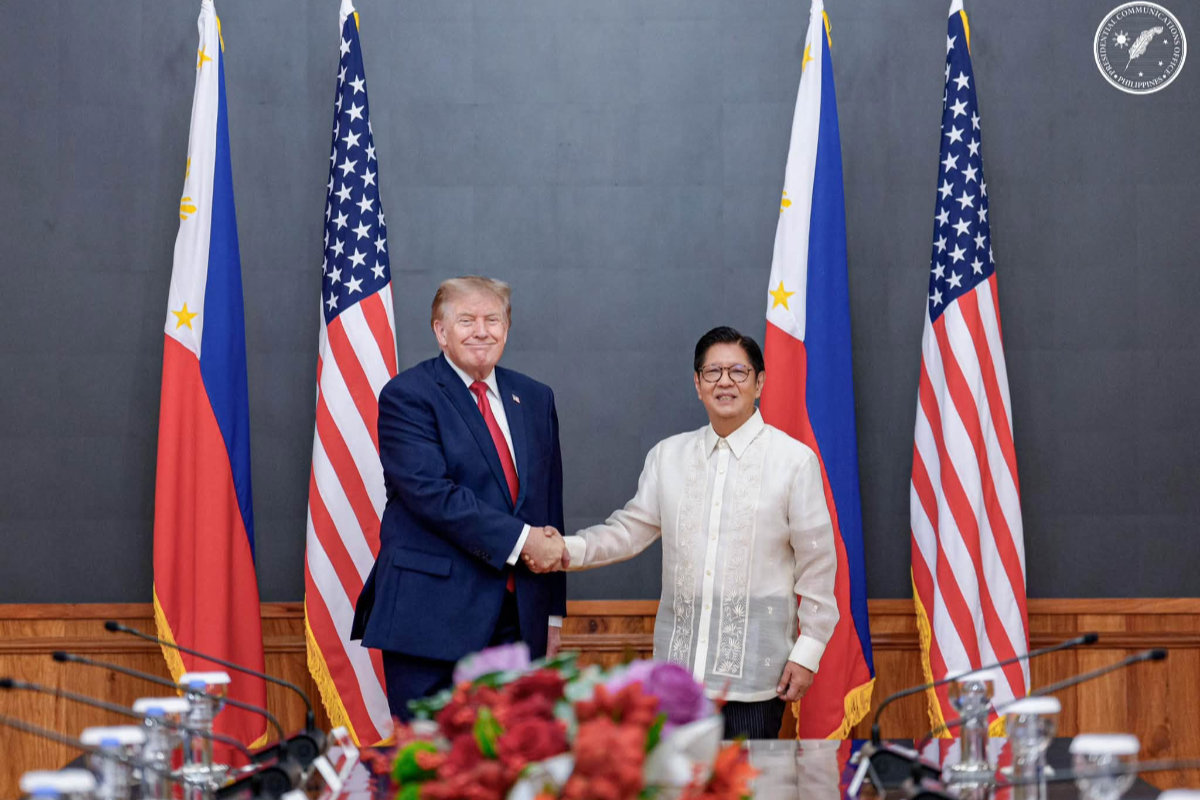
The United States and the Philippines announced about $14.74 billion in aircraft, defense financing, satellite and infrastructure deals during President Donald Trump’s two-day state visit to Manila, according to a White House fact sheet issued November 18. The White House says that the package supports more than 56,440 American jobs.
The largest item is a plane order. Boeing and GE Aerospace finalized a sale to Philippine Airlines for up to 20 Boeing 787 aircraft with GE Aerospace engines. The White House values it at $12 billion and says it supports 47,000 U.S. jobs.
Most of the rest is defense. It includes a bilateral Foreign Military Financing (FMF) loan package of more than $2 billion for defense and security equipment from U.S. suppliers, which it says supports over 7,000 U.S. jobs.
Another $400 million in direct FMF will go to the Philippine military to expand its operational reach, long-range fires, command and control, critical infrastructure and multi-domain drones. The White House describes this as South China Sea deterrence and links it to 1,500 U.S. jobs.
The Department of National Defense is also part of two smaller deals. One is a $63 million effort with U.S. tech providers to modernize its defense cloud infrastructure for Super Intelligence (SI) use cases, tied to over 200 U.S. jobs. The other is a $37 million contract with a U.S. firm for SI-enabled mission support and military interoperability, tied to 140 jobs.
At Subic Bay, Subic Grain will build a new $40 million fuel storage depot to support U.S. military and commercial operations. Astranis is offering connectivity services from its U.S.-made AGILA satellite for Philippine government and public communications, worth up to $200 million and 600 jobs.
The $14.74 billion total mixes finalized agreements, financing and commercial opportunities, so it is not all signed contracts.
On trade, both leaders committed to eliminating the U.S. trade deficit with the Philippines by expanding Philippine imports of American energy and agricultural products. Specific tariff rate adjustments and purchase quotas were not detailed in the announcement.
Three more items are at the planning stage. The two countries announced plans to explore an intergovernmental civil-nuclear agreement, the first of its kind between the U.S. and an Indo-Pacific partner, to generate gigawatts of power in the Philippines and open markets for U.S. nuclear technology firms.
They also agreed to partner on supplying the Philippines’ sovereign cloud infrastructure with U.S. Super Intelligence technology under the U.S. SI Exports Program. The Philippines also announced plans to modernize Basco Airport in its northernmost islands to support U.S.-Philippine operational access, disaster response and commercial supply chains.
The fact sheet gives no costs or timelines for the nuclear, cloud or Basco projects. The $14.74 billion covers only the U.S.-Philippines package. The White House puts the wider Southeast Asia trip, which included the ASEAN Summit and agreements with Thailand, Indonesia, Malaysia and Brunei, at over $17 billion.