



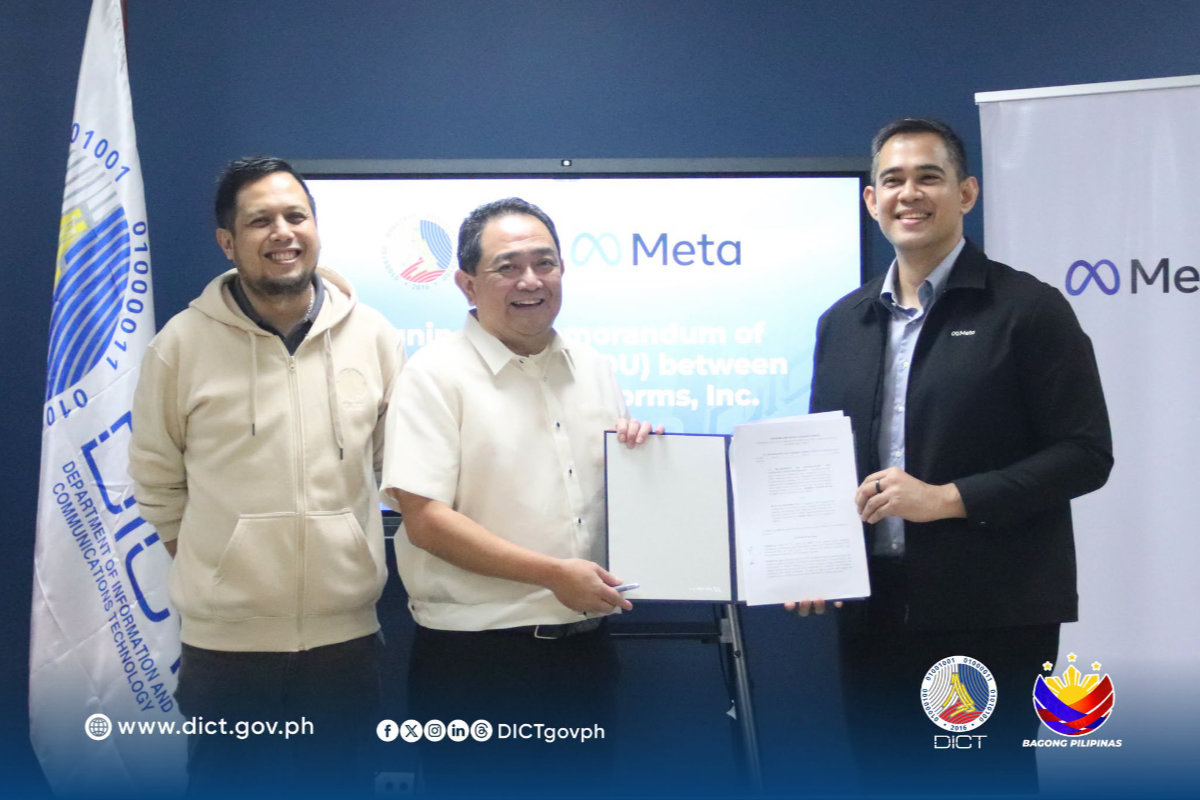
The Department of Information and Communications Technology (DICT) and Meta Platforms, Inc. signed a memorandum of understanding (MOU) in Quezon City on Tuesday, November 24, to strengthen online safety for Filipinos, with a focus on children and young people.
DICT Secretary Robert Joseph de Claro and Gio Tingson, Meta’s head of public policy for the Philippines, led the signing. Cybercrime Investigation and Coordinating Center (CICC) Executive Director Undersecretary Renato Paraiso witnessed it.
Under the agreement, DICT and Meta will strengthen coordination and measures against online scams, fraudulent activities, harmful content, AI-generated deepfakes and online child exploitation, according to the department.
The MOU also provides for wider digital literacy programs for children, parents and teachers. It includes support for Filipino entrepreneurs and micro, small and medium enterprises (MSMEs) that use digital technologies.
DICT said the signing follows a directive from President Ferdinand Marcos Jr. to deepen cooperation between government and the private sector in protecting Filipinos in the digital space. The announcement did not specify timelines, targets or funding for the programs.
Background
The signing follows several exchanges between the two sides this year. In February, DICT announced an agreement with Meta covering child protection, online scams and harmful deepfakes. In late August, the department said Meta agreed to form a technical working group to improve coordination and response times on harmful content, online threats and child sexual abuse material.
In September, then-DICT Secretary Henry Aguda said Facebook had yet to sign an MOU on safety measures already discussed with the government. Aguda resigned in October, and de Claro was appointed on October 13. The DICT announcement did not say whether the MOU signed on Tuesday is the same document Aguda described.
Scams in the Philippines
The Global Anti-Scam Alliance’s State of Scams Philippines 2026 report found that 84 percent of Filipino adults encountered a scam this year, up from 77 percent in 2025. Of those who encountered a scam, 44 percent interacted with it and 15 percent lost money. The report estimated that Filipino adults lost ₱121.8 billion to scams over the past year, an average of ₱10,427 per victim.
Official law enforcement data showed recorded online scam cases fell 18.4 percent in the first half of 2026, from 5,526 cases in the same period last year to 4,509.
Scam victims can report incidents to the CICC hotline at 1326.
DICT said that the MOU is meant to build a digital space that is safer, better prepared for online risks and offers more opportunities for Filipinos. It has not announced how the commitments will be carried out.