



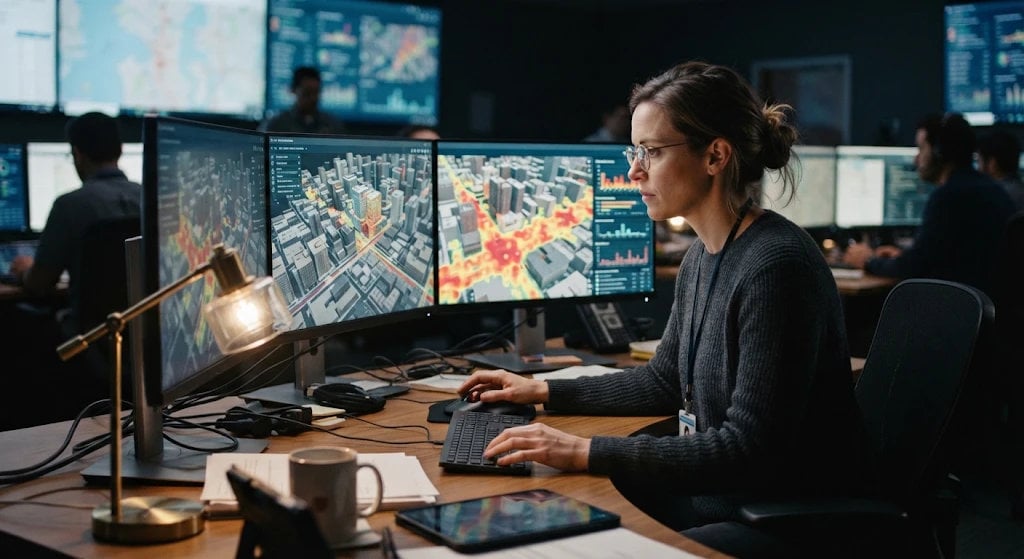
When an 80,000-seat stadium prepares to host a championship final, a massive marathon, or a global music festival, the logistical challenge extends far beyond the stadium gates. Millions of dollars are spent on athletic preparation, security protocols, and ticketing infrastructure, yet a city’s true vulnerability lies in its surrounding transit networks, pedestrian walkways, subway stations, and bottleneck intersections. In the past, urban planners and municipal authorities relied on historical guesswork, static zoning maps, and reactive crowd management strategies to handle massive influxes of visitors. Today, forward-thinking metropolitan areas are revolutionizing urban planning through digital twins—high-fidelity, real-time virtual replicas of entire city districts that simulate human movement and infrastructure dynamics long before a single spectator arrives.
The Anatomy of an Urban Digital Twin
To understand how digital twins transform municipal logistics, we must examine what separates them from traditional 3D modeling or CAD simulations. A digital twin is not merely a static digital rendering of a city; it is a dynamic, data-driven ecosystem.
By integrating continuous data feeds from IoT sensors, CCTV feeds, public transit GPS trackers, historical ticketing databases, and weather forecasts, a digital twin creates a living, breathing virtual replica of the urban environment.
- Real-Time Data Ingestion: The virtual model mirrors live conditions in the physical world, updating traffic light timings, train capacities, and pedestrian density metrics second by second.
- Agent-Based Modeling (ABM): Advanced simulation engines populate the digital twin with thousands of autonomous digital “agents,” each programmed with distinct behavioral rules, walking speeds, transit preferences, and destination targets.
- Multi-Variable Stress Testing: Planners can inject extreme scenarios into the virtual environment—such as a sudden train breakdown at the central subway station or an unexpected torrential downpour at halftime—to observe how crowds react and where choke points emerge.
Simulating Crowd Flow Before the Kickoff
Months before a major sporting event takes place, municipal engineers use digital twins to stress-test pedestrian flow and transit capacity under worst-case conditions:
- Identifying Invisible Bottlenecks: Simulations frequently reveal counter-intuitive flaws in urban design, such as narrow stairwells exiting a metro station that create dangerous crowd compression when thousands of fans attempt to leave simultaneously.
- Optimizing Transit Timetables: Planners can test dozens of alternative subway schedules and bus dispatch frequencies virtually, finding the exact configuration required to clear 50,000 fans from a district within 45 minutes.
- Dynamic Wayfinding and Barrier Placement: By observing how digital crowds naturally disperse or cluster around physical obstacles, city planners can dynamically position temporary security checkpoints, queue barriers, and emergency exit routes to maintain smooth, continuous movement.
The Psychological Toll of Urban Congestion and Dense Environments
While digital twins allow municipal planners to engineer flawless logistical choreography, navigating physical crowds of tens of thousands of people places an intense, hidden tax on the human nervous system.
Navigating dense crowds, dodging erratic pedestrian movements, and enduring noisy transit hubs floods the brain with sensory inputs, keeping the amygdala on high alert and spiking cortisol levels long before a spectator ever reaches their stadium seat. To counteract this sensory overload and protect cognitive wellbeing, many urban dwellers and event attendees deliberately seek out moments of calm isolation before or after large gatherings. Stepping away from the roar of the crowd to enjoy a quiet, unburdened mental reset—such as taking a relaxing, zero-stakes pause with a tactile visual puzzle or a casual moment at a btc casino—allows the nervous system to disconnect from high-stimulus environments. Disengaging from urban congestion and performance metrics gives the prefrontal cortex the vital whitespace it needs to restore equilibrium.
The Resilient Cities of Tomorrow
Digital twins represent a profound evolution in how humanity manages physical space. By shifting from reactive crowd control to proactive, simulation-driven urban design, modern cities bridge the gap between chaotic human behavior and structural engineering. The result is a smarter, safer urban ecosystem where massive events unfold seamlessly, protecting both the flow of commerce and the peace of mind of every citizen.