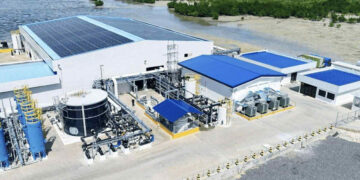



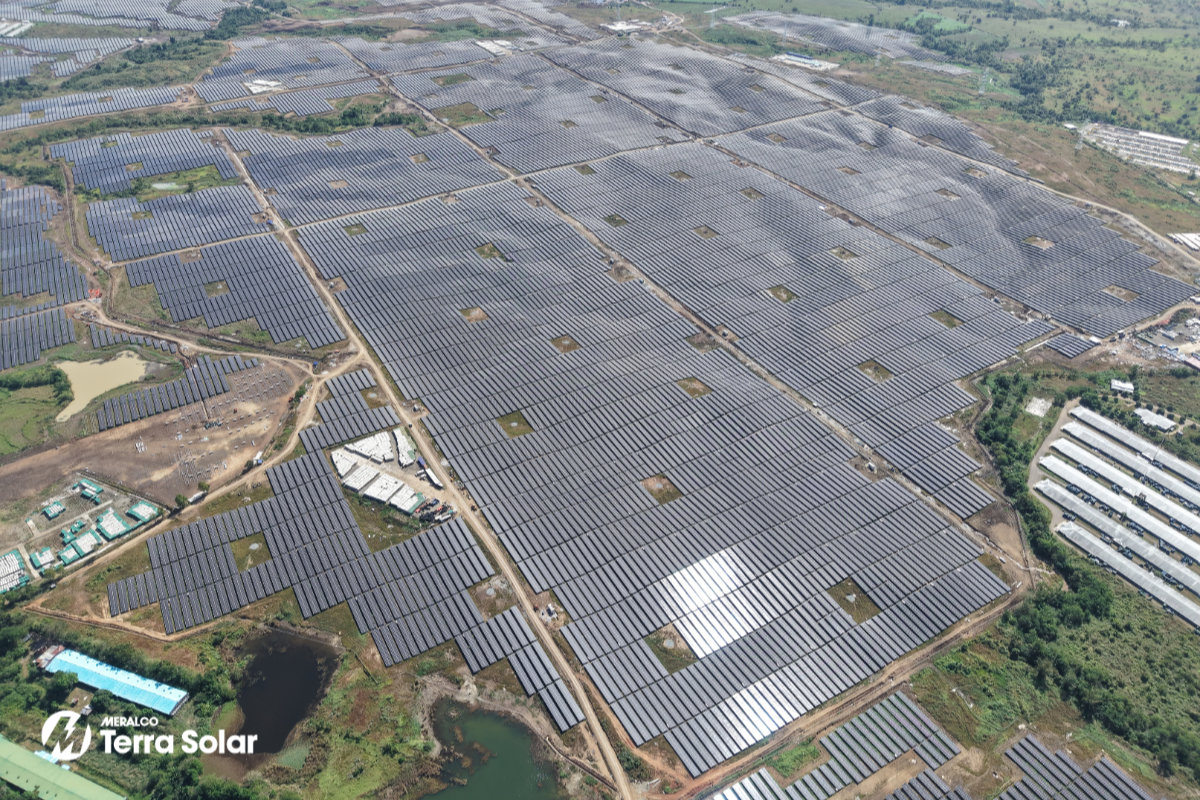
President Ferdinand Marcos Jr. inaugurated the first phase of the MTerra Solar Project in Gapan City, Nueva Ecija last month. Developers call it the world’s largest integrated solar and battery storage facility built on a single site.
Once complete, MTerra is expected to power roughly 2.4 million Filipino households and cover about 10 percent of Luzon’s electricity demand, Energy Secretary Sharon Garin said.
Phase 1 is about 91 percent complete. It has already energized 1,373 megawatts of solar capacity and 825 megawatt-hours of battery storage, feeding into the grid ahead of full commissioning. Meralco PowerGen Corp. (MGen) president and CEO Emmanuel Rubio said grid testing is scheduled for the first week of August, followed by a 24-to-30-day evaluation period before the plant goes live.
“The grid testing of MTerra Solar Phase 1 will be done I think in the first week of August… afterwards, we will wait for the results which will last around 24 to 30 days, so I think September is when we will start commercial operations,” Rubio said.
The completed project will span 3,500 hectares across five towns in Nueva Ecija and Bulacan, delivering up to 3,500 megawatts peak of solar capacity with 4,500 megawatt-hours of battery storage. Phase 2, due by the first quarter of 2027, adds 1,000 megawatts and 1,200 megawatt-hours. The build cost more than ₱200 billion (about $4 billion). It’s a joint venture between Meralco PowerGen and UK-based Actis, which holds a 40 percent stake.
“This achievement comes at a time when the need to boost our energy sector has never been more apparent,” Marcos said at the inauguration. “These capabilities will help strengthen the stability of our power system while expanding the role of clean energy in our power generation mix. Equally, importantly, its impact will be felt in the daily lives of our people.”
The numbers behind the project point to how far the Philippines still has to go. Coal made up 57 percent of the country’s power generation in 2025; renewables, 25 percent. The government wants that renewable share at 35 percent by 2030.
Between July 2022 and May 2026, the Department of Energy awarded 605 renewable energy service contracts, and installed battery storage capacity grew from 93 megawatts to 845 megawatts. Regulators have said the broader rollout is still running behind the government’s own targets.
Phase 1 is expected to reach full commercial operations by September. Phase 2 remains on track for early 2027.