


Do you know that if you’ve been laid off, and not because of anything you did, you may be entitled to a cash payout from SSS? Few Filipino workers know that SSS unemployment benefits exist and even fewer apply for it.
The Social Security System (SSS) unemployment benefit, formally known as the unemployment insurance or involuntary separation benefit, provides a cash payout to qualified SSS members who lose their jobs through no fault of their own. It is a benefit – not a loan – which means that members are not required to pay it back.
The program was introduced under Republic Act No. 11199 or the Social Security Act of 2018, and covers involuntary separations that occurred on or after March 5, 2019. It applies to covered employees, kasambahays, and Overseas Filipino Workers (OFWs) who meet the eligibility requirements set by SSS.
If you were recently terminated from your job due to redundancy, retrenchment, company closure, or even illness, you may be eligible to receive SSS unemployment benefits. Applying for these benefits takes only a few minutes through the My.SSS portal, and I’m here to teach you how to do it.
Table of Contents
Who Qualifies for SSS Unemployment Benefits
You must meet all of the following conditions to qualify for SSS unemployment benefits:
- Age – You must not be over 60 years old at the time of involuntary separation. Underground or surface mineworkers must not be over 50, and racehorse jockeys must not be over 55.
- Contributions – You must have paid at least 36 monthly contributions, with at least 12 of those falling within the 18-month period immediately before the month of separation.
- No recent claim – You must not have received a settled unemployment benefit within the three (3) years prior to the current claim.
- Valid cause of separation – The job loss must fall under one of the recognized grounds for involuntary separation.
Recognized Grounds for Involuntary Separation
SSS recognizes the authorized causes for termination under Articles 298 and 299 of the Labor Code, as amended:
| Cause | Description |
|---|---|
| Installation of labor-saving devices | Employer automation that eliminates the employee’s position |
| Redundancy | Position deemed excess relative to business needs |
| Retrenchment or downsizing | Reduction in workforce due to business losses |
| Closure or cessation of operations | Full or partial shutdown of the business |
| Disease or illness | Continued employment prohibited by law or harmful to the employee or co-workers |
SSS also recognizes separation initiated by the employee under Article 300 of the Labor Code, provided that the employee can substantiate the ground with evidence. These include serious insult by the employer, inhuman or unbearable treatment, or the commission of a crime against the employee or their family by the employer.
Economic downturn, natural or human-induced calamities, and other analogous cases as determined by the Department of Labor and Employment (DOLE) and SSS are also covered.
Who Are Disqualified From Benefits
Employees terminated for just causes under Article 297 of the Labor Code are not eligible for SSS unemployment benefits. These causes include serious misconduct, willful disobedience, gross and habitual neglect of duty, fraud or breach of trust, commission of a crime, and analogous cases such as abandonment or gross inefficiency.
Several other situations fall outside the program’s coverage:
- Resignation – Voluntary resignation does not qualify, since the benefit applies only to involuntary separation.
- Expired contracts – Workers whose fixed-term contracts simply ended, without a formal termination, are not considered involuntarily separated.
- Floating or furlough status – Employees placed on floating status are not yet considered separated unless their contract expires without recall, or the suspension of employer-employee relations extends beyond six months due to serious economic downturn.
- Temporary layoffs – Only permanent separation qualifies for unemployment benefits.
How Much the Benefit Pays
The benefit is computed as 50 percent of the member’s Average Monthly Salary Credit (AMSC), paid for a maximum of two months.
Unemployment Benefit = AMSC × 50% × 2 months
The Monthly Salary Credit (MSC) is the bracket SSS assigns to a member’s compensation, used for both contributions and benefit computation. Effective January 2026, the MSC ranges from a minimum of ₱5,000 to a maximum of ₱35,000 for most members, following the final scheduled contribution rate adjustment under RA 11199. Kasambahays have a lower floor of ₱1,000, and OFWs start at ₱8,000.
The AMSC, meanwhile, is the higher of two computations set out in the law:
- The sum of the last 60 monthly salary credits before the semester of contingency, divided by 60; or
- The sum of all monthly salary credits paid before the semester of contingency, divided by the number of months in which contributions were paid.
For a member whose MSC has remained at ₱15,000, for example, the AMSC would also be ₱15,000. Half of that amount, ₱7,500, is paid for each of the two covered months, for a total benefit of ₱15,000.
Limits on the Benefit
A member may claim the unemployment benefit only once every three (3) years, counted from the date of involuntary separation. If a member qualifies for two or more compensable benefits within the same period, such as unemployment and sickness benefits overlapping, SSS pays only the higher of the two – not both.
The settled benefit may also be deducted, in part or in full, from the member’s future SSS benefits if any of the following occur:
- The benefit overlaps with another compensable contingency.
- A labor case filed by the member against the employer is resolved in the employer’s favor, or results in reinstatement with back wages.
- The member is rehired within the compensable period, or within two months of separation.
- The claim is later found to involve misrepresentation, fraud, or falsification, in which case SSS may also pursue liability under Section 28 of RA 11199.
SSS Unemployment Benefits Requirements
To file a claim for SSS unemployment benefits, prepare the following requirements:
- A valid government-issued ID – Acceptable primary IDs include the UMID card, MySSS card, passport, driver’s license, PRC ID, and voter’s ID, among others. Members without a primary ID may submit two secondary IDs, at least one of which bears a photo and both of which bear a signature.
- DOLE Certification of Involuntary Separation – This document, together with the employer’s Notice of Termination or a notarized Affidavit of Termination of Employment, establishes the fact and date of separation. For OFWs, this is issued by the Philippine Overseas Labor Office (POLO) or the Philippine Overseas Employment Agency (POEA).
- A disbursement account – SSS pays the benefit through a UMID ATM card, a MySSS card, an SSS-enrolled bank account, or an accredited e-wallet, enrolled through the Disbursement Account Enrollment Module (DAEM) of the My.SSS portal. Read this article to learn how to enroll a disbursement account on the My.SSS portal.
How to File a Claim for SSS Unemployment Benefits
SSS processes unemployment benefit claims through the My.SSS online member portal. Filing takes place in two phases: an online application with SSS, followed by a separate application for electronic certification of the involuntary separation with DOLE, POLO, or POEA.
Phase 1: File the Claim with SSS
Step 1: Log in to My.SSS
Go to the My.SSS member portal and log in using your User ID and password. If you forgot your login credentials, read this article to learn how to retrieve them.
Step 2: Open the Unemployment Benefit application page
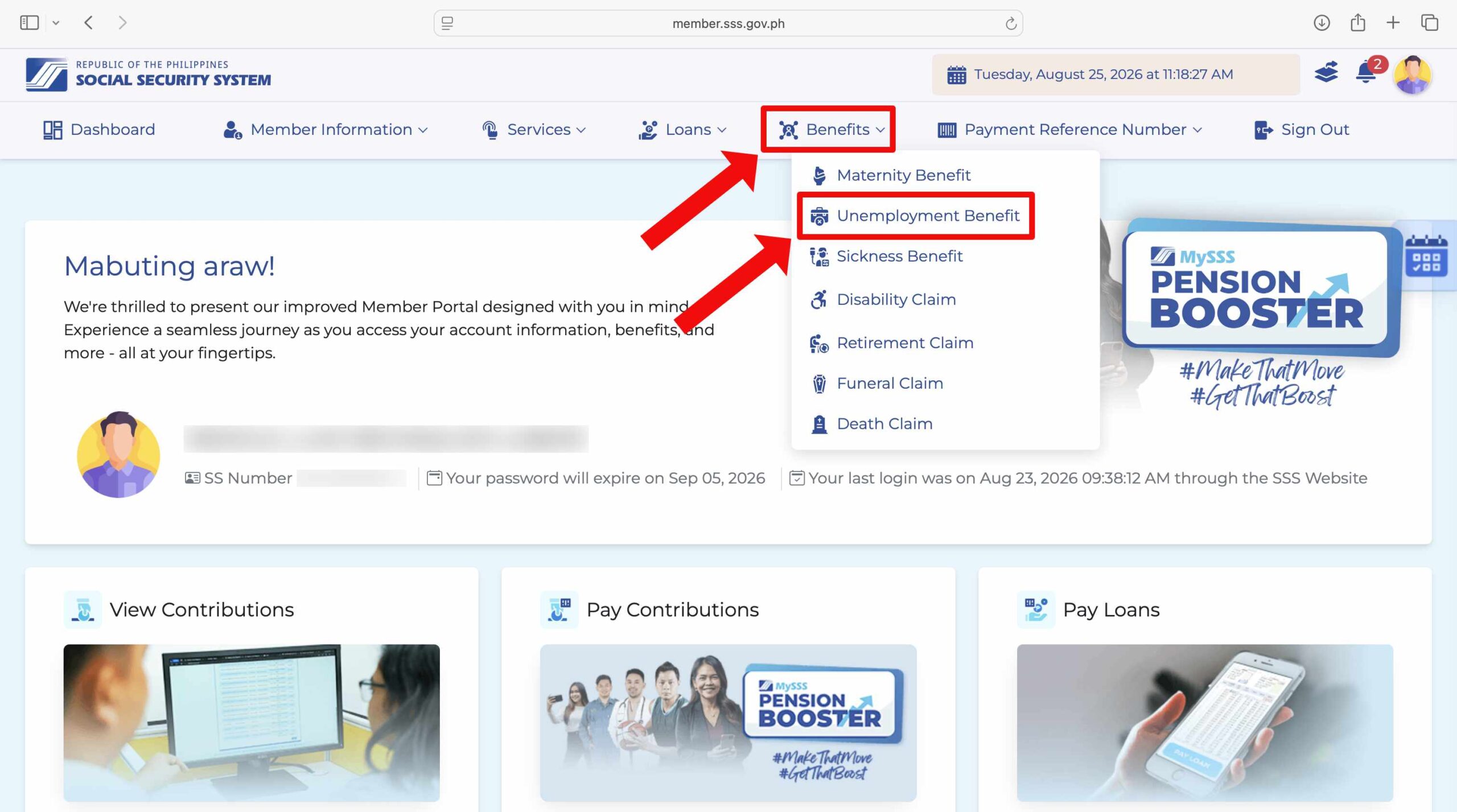
Once logged in to your My.SSS account, click Benefits on the top menu, and then select Unemployment Benefit from the dropdown list.
Step 3: Fill out the application form
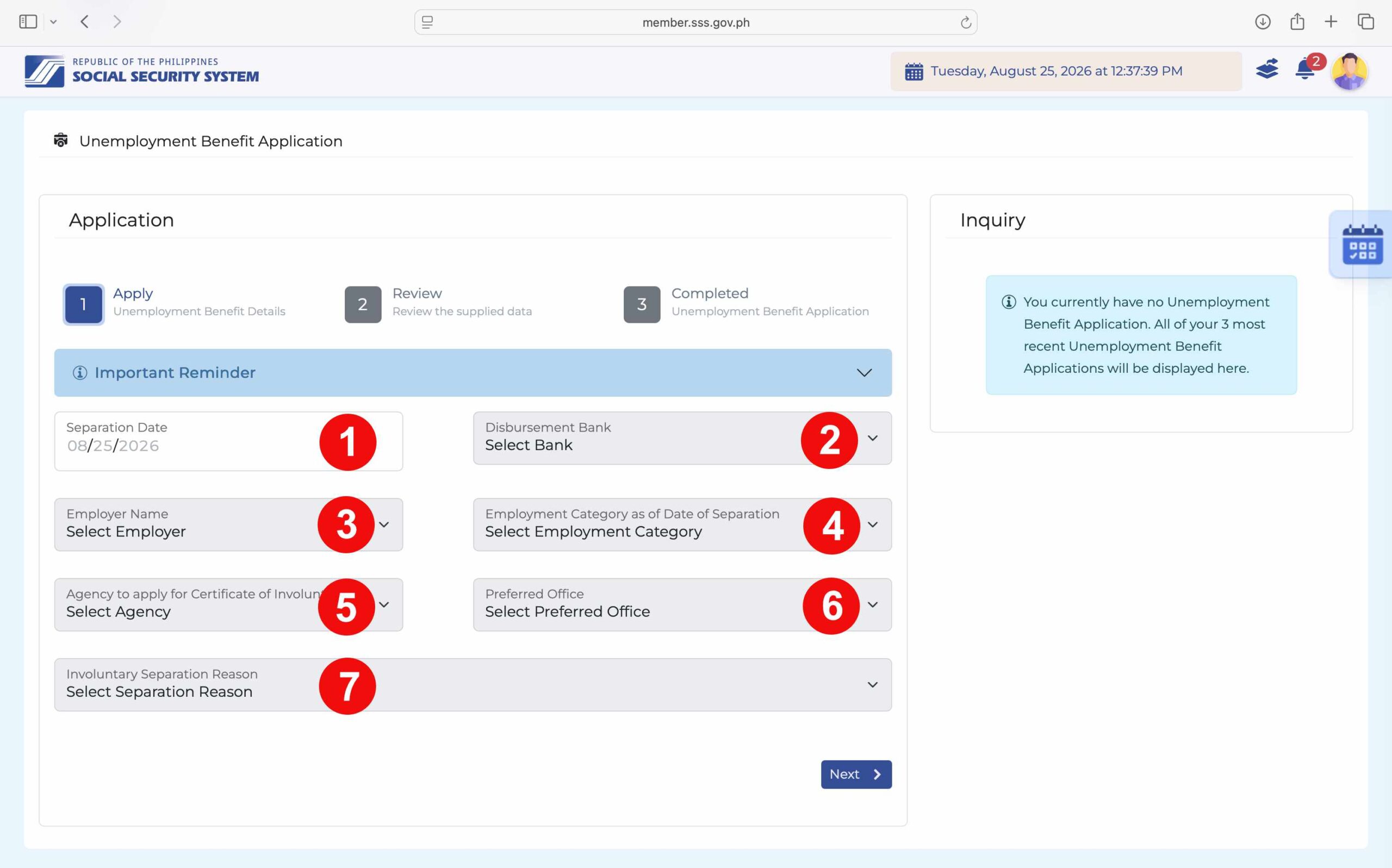
Enter or provide the details of your SSS unemployment benefit application, as follows:
- Separation Date – The date of your involuntary separation from employment.
- Disbursement Bank – The enrolled account or card that will receive the benefit. Read this article to learn how to enroll a disbursement account in SSS.
- Employer Name – Select the name of your former employer.
- Employment Category as of Date of Separation – Choose your employment category, such as covered employee, mine worker, racehorse jockey, OFW, or household helper.
- Agency to apply for Certificate of Involuntary Separation – Select the agency, such as DOLE, POLO, or POEA, that will confirm the separation.
- Preferred Office – Choose the specific field office or regional office of the selected agency.
- Involuntary Separation Reason – Indicate the ground for separation, selected from the list of qualifying reasons, such as redundancy, closure or cessation of operation, retrenchment, etc.
Once all fields are complete, click Next.
Step 4: Review and certify
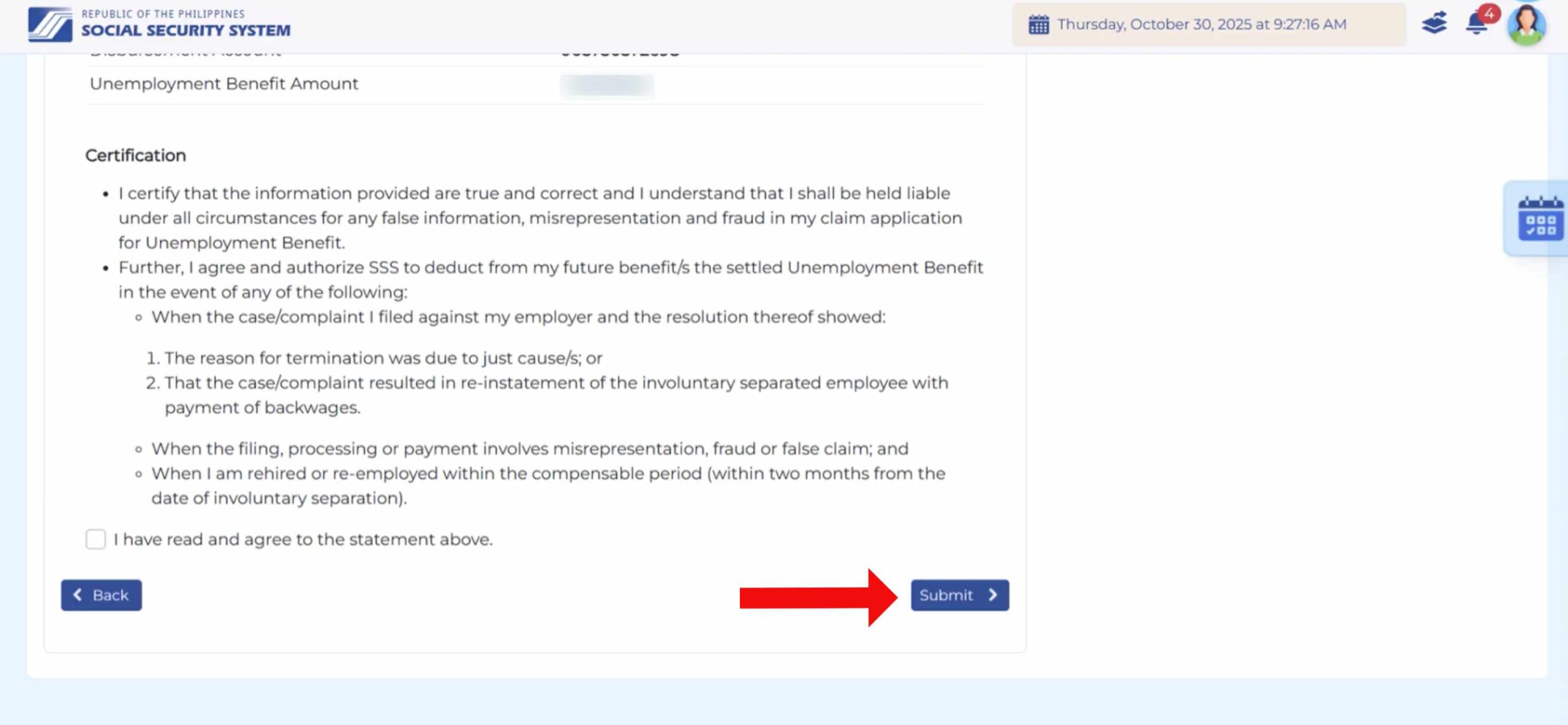
Review the details of your SSS unemployment benefit claim. If anything is wrong, click the Back button to change it.
Read the Certification statement carefully and then check “I have read and agree to the statement above.” Click Submit to continue.
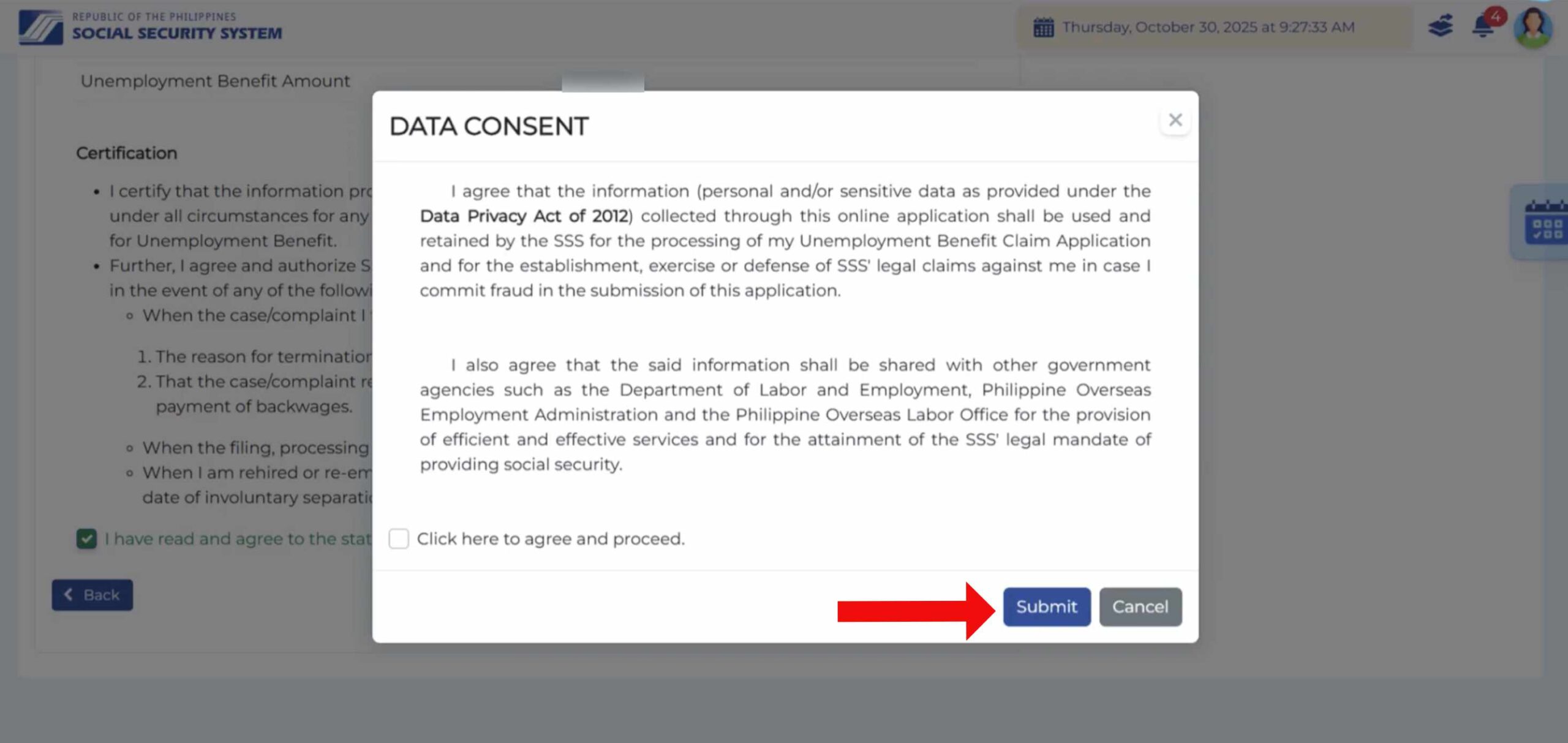
A Data Consent pop-up appears, citing the Data Privacy Act of 2012, and states that the submitted information may be shared with DOLE, POEA, and POLO for processing.
Check the box for “Click here to agree and proceed,” and then click Submit to finalize the application.
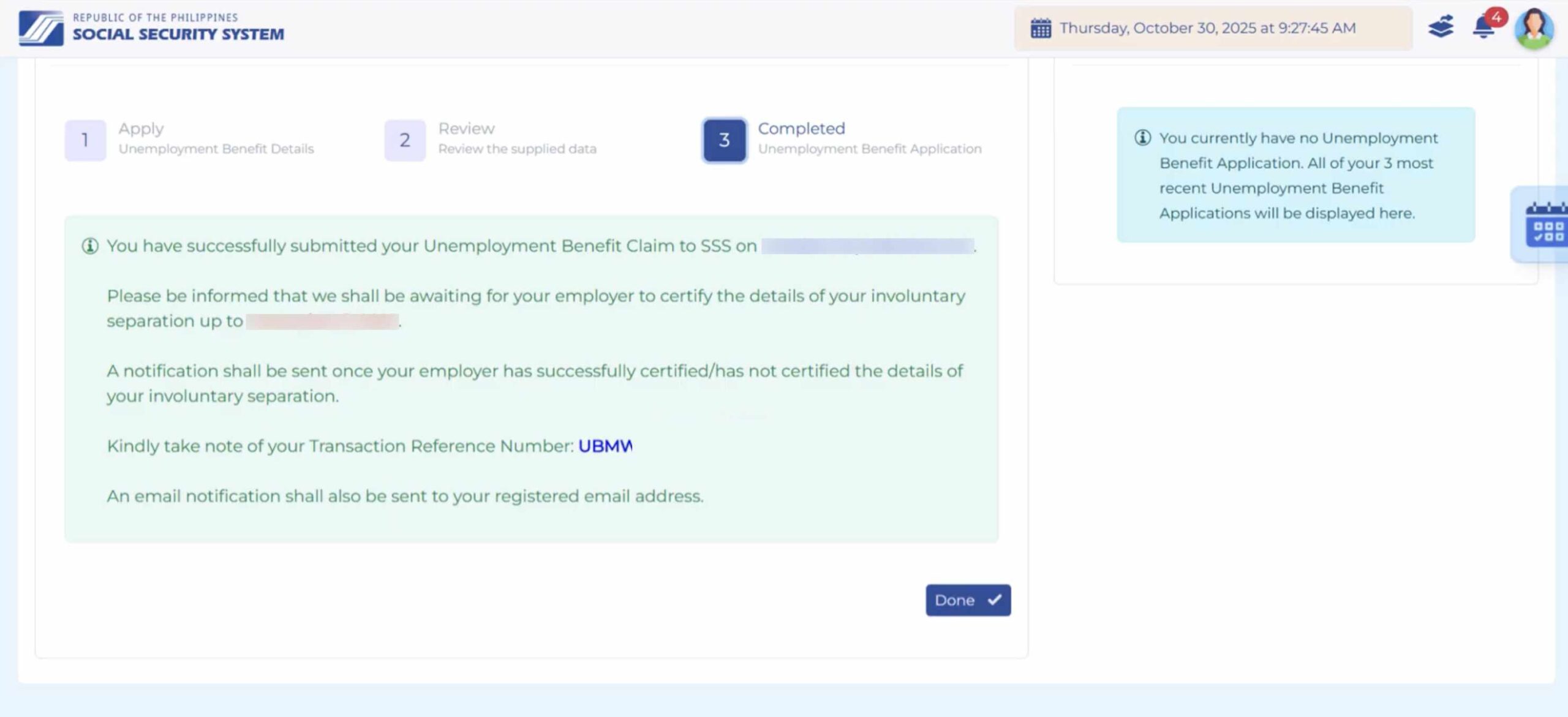
Step 5: Unemployment benefit claim submitted
Once submitted, the portal confirms that the Unemployment Benefit Claim has been submitted and displays a Transaction Reference Number. Take note of this number for record-keeping purposes.
For your claim to be approved and the benefit released, the Certificate of Involuntary Separation must be certified by your employer. You will be notified by email once the certification is completed.
Phase 2: Secure the Certificate of Involuntary Separation
Filing with SSS alone doesn’t complete the unemployment benefit claim. Your most recent employer must first confirm the separation details through their own My.SSS account, after which, you must separately apply to DOLE, POLO, or POEA for the Electronic Certification of Involuntary Separation, using the transaction number generated in Phase 1.
Step 1: Apply for the certification
Submit an application for Electronic Certification of Involuntary Separation to the DOLE Field or Provincial Office where the employer is located, or to the relevant POLO or POEA office for OFWs, either in person or through the agency’s online facility.
Provide or submit the following during your application:
- Transaction Number provided in the SSS e-mail notification;
- One (1) valid ID with signature and photo;
- Copy of Notice of Termination of Employment issued by the employer or Duly Notarized Affidavit of Termination of Employment, in the absence of Notice of Termination of Employment;
- If you’re an OFW, the Affidavit of Termination of Employment should be supported by an Employment Contract verified by POLO and/or proof of OFW’s arrival to the Philippines such as stamp of arrival by the Bureau of Immigration in the OFW’s Passport or other similar documents; and
- Certificate of Pending Case and/or Police Report, if applicable.
Step 2: DOLE, POLO, or POEA verification
The receiving office checks the application against the SSS online filing system to confirm that the member has completed the initial submission, then verifies the details against the employer’s Establishment Report or the OFW Information Record maintained by POEA.
Step 3: Certification and claim approval
Once verified, the office encodes and certifies the involuntary separation electronically, typically within three working days of a complete application.
SSS approves the claim once this certification is received, and notifies the member by email once the benefit has been credited to the enrolled disbursement account. A printed copy of the DOLE certification is no longer required for SSS to approve the claim, since confirmation now passes electronically between the two agencies.
Frequently Asked Questions
Can an employee who resigned claim SSS unemployment benefits?
No. The benefit is limited to involuntary separation. Employees who resign voluntarily will not be issued a DOLE certification, which is a required document for the claim.
Does having an existing SSS loan affect eligibility for the unemployment benefit?
No. The unemployment benefit is a separate cash benefit, not a loan, so an outstanding SSS loan doesn’t disqualify a member from claiming it.
Are workers who lost their jobs due to contract expiration (“endo”) covered?
No. A claim requires a formal termination and a corresponding DOLE certification. Since a contract that simply lapses doesn’t involve termination, workers in this situation do not qualify.
Can a member who gets rehired shortly after filing still receive the benefit?
A member rehired within the compensable period, defined as within two months of separation, may still receive the unemployment benefit, but the settled amount will be deducted, in part or in full, from future SSS benefits.
How long does SSS take to release the unemployment benefit?
Once a claim is approved, SSS typically credits the benefit to the member’s enrolled disbursement account within five to ten working days.
Can a voluntary SSS member claim the unemployment benefit?
No. The benefit is available only to compulsorily covered employees, household helpers (kasambahays), and OFWs who were involuntarily separated from employment. Voluntary members are not eligible.
Wrapping Up
The SSS unemployment benefit provides displaced workers with a cash payout intended to cover living expenses during the transition between jobs. Paid as a lump sum equivalent to two months of the member’s average monthly salary credit, the benefit is not a loan and does not require repayment under ordinary circumstances.
Eligibility for SSS unemployment benefits depends on meeting the contribution requirements, the age limit, and one of the recognized grounds for involuntary separation. Members who lose their jobs through causes such as redundancy, retrenchment, or business closure may claim the benefit once every three years, provided the application is filed within one year of separation and the required certification of involuntary separation is obtained.
If you have any questions and concerns, you may call the SSS 24/7 hotline 1455 or email [email protected].