


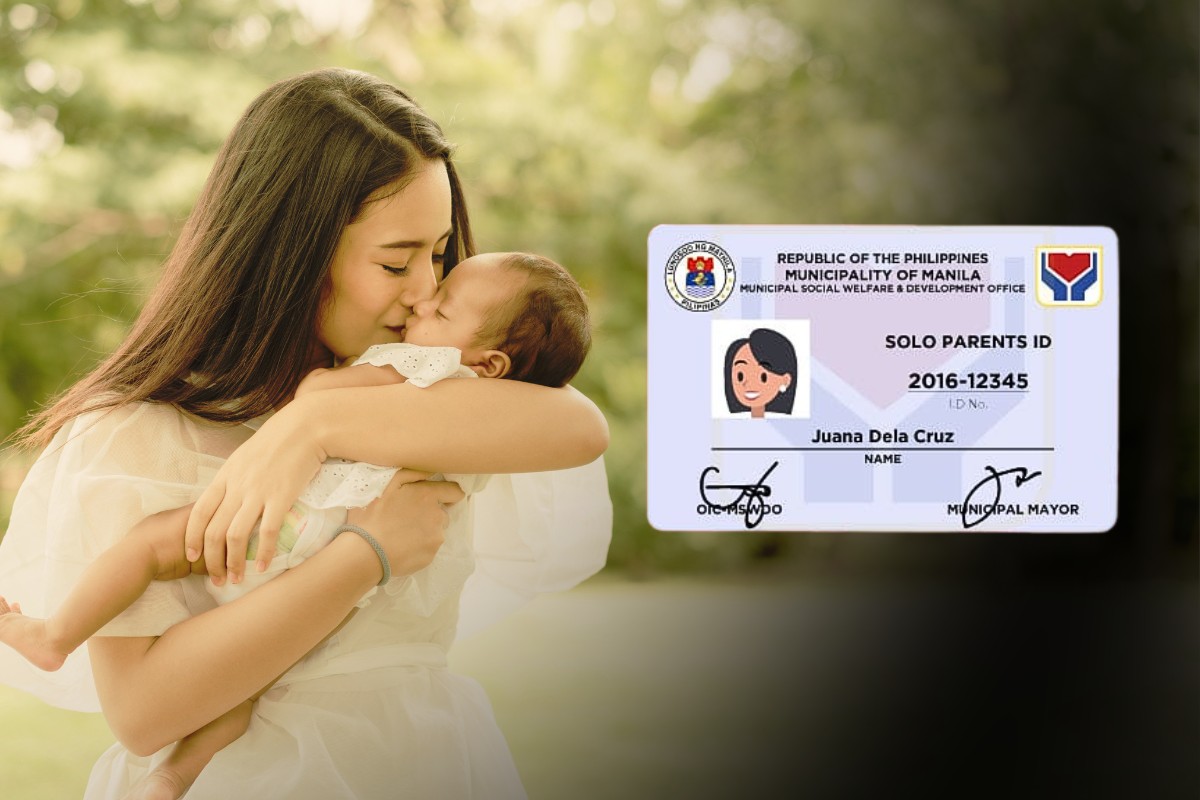
Are you a solo parent? If you’re the one paying for milk, bringing your child to school, and staying up all night when they’re sick – all without a partner supporting you – there’s a government ID created for exactly that situation. It’s called the Solo Parent ID, and you might be wondering if you’re qualified to get one.
What most people don’t realize is how wide the coverage actually is. The law isn’t limited to widowed or separated parents. It covers OFW spouses, guardians raising a relative’s child, unmarried parents, and even pregnant women without a supporting partner – each with its own documentary requirements.
In this guide, I’ll discuss the qualifications for the Solo Parent ID, which documents the DSWD requires depending on your situation, how to file your application, and what benefits you can avail if you’re approved.
Table of Contents
What is the Solo Parent ID?
The Solo Parent ID is issued under Republic Act No. 11861, or the Expanded Solo Parents Welfare Act, which was signed into law by President Rodrigo Duterte in 2022. The law officially recognizes solo parents who are raising a child mostly or entirely on their own, and provides benefits like paid leave, school subsidies, and discounts on essentials.
The Solo Parent ID is applied at and processed through your local government unit (LGU), specifically the local social welfare and development office. There is no online application website yet, as of this writing.
Who Qualifies for a Solo Parent ID
Under RA 11861, you may qualify as a solo parent if you are:
- A mother solely raising a child born as a result of rape, even without a final conviction
- A parent whose spouse has died
- A parent whose spouse has been detained or imprisoned for at least 3 months
- A parent whose spouse has a physical or mental incapacity
- A parent who has been legally or de facto separated from a spouse for at least 6 months, with sole custody and support of the child
- A parent with sole custody after annulment, declaration of nullity of marriage, or divorce
- A parent abandoned by a spouse for at least 6 months
- A spouse, family member, or guardian of a low- or semi-skilled overseas Filipino worker (OFW) who has stayed abroad continuously for at least 12 months
- An unmarried mother or father solely raising a child
- A legal guardian, adoptive parent, or foster parent solely caring for a child
- A relative within the fourth degree of consanguinity or affinity who took over parental care because the parents died, disappeared, abandoned the child, or have been absent for a prolonged period
- A pregnant woman solely responsible for supporting and caring for her unborn child
Note: The DSWD has clarified that solo parents currently cohabiting with a partner – married or not – and regardless of gender, don’t qualify. If you’re living with someone in a partner-like arrangement, your application may be rejected.
You’ll also need a qualifying dependent who is unmarried, and either unemployed or 22 years old and below. If your dependent is older than 22, they’ll still count if they have a physical or mental disability or are medically unable to support themselves.
Documentary Requirements (Based on Your Situation)
Every applicant, regardless of category, needs these three primary documents:
- PSA-issued birth certificate of the child or dependent
- A sworn affidavit stating you don’t have a live-in spouse or partner, or that you’re the sole caregiver of the child
- A sworn affidavit from a barangay official confirming your residency
Aside from these aforementioned documents, you also need to submit these additional requirements depending on your specific situation:
| Category (Specific Situation) | Supporting Documents Required |
|---|---|
| Spouse passed away | Marriage certificate; death certificate of the spouse |
| Spouse imprisoned | Marriage certificate; certificate of detention proving at least 3 months of imprisonment |
| Spouse has physical/mental disability | Marriage certificate; medical records, medical abstract, certificate of confinement, or valid PWD ID |
| Legally or de facto separated | Marriage certificate; judicial decree of legal separation (or affidavit proving the separation agreement, for de facto cases) |
| Marriage annulled or declared null | Marriage certificate; judicial decree declaring the marriage null and void |
| Abandoned by spouse | Marriage certificate; affidavit proving abandonment; police or barangay certification confirming it |
| Spouse is a low-income OFW abroad | Marriage or birth certificate proving relationship to the OFW; POEA standard employment contract; photocopy of OFW’s passport with immigration stamps; proof of the OFW’s income; certificate of employment proving at least 12 months of overseas work |
| Relative (within 4th civil degree) raising the child | Death certificate or proof no parent/guardian can care for the child; police or barangay records supporting the situation; proof of relationship to the child’s biological parent or guardian |
| Legal guardian, adoptive, or foster parent | Court order of legal guardianship; adoption decree from the National Authority for Child Care, or foster care placement document from DSWD/NACC |
| Pregnant without partner support | Medical certificate or pregnancy report |
| Unmarried parent | Certificate of No Marriage (CENOMAR) |
if you’re planning to apply for financial assistance on top of the ID itself, such as discounts and cash subsidies, you will need proof of low income as well. Unemployed applicants must submit a sworn affidavit stating that they currently don’t have a job or income source. Employed applicants with low income may also have to submit an Income Tax Return, Certificate of Employment, Social Case Study Report, proof of income, or Certificate of Indigency.
How to Apply for a Solo Parent ID
Step 1: Confirm Your Category and Prepare Documents
Look up your specific situation on the table above and prepare both the primary documents and the case-specific supporting documents. For example, if you’re an unmarried parent, prepare your CENOMAR along with the primary documents (birth certificate and sworn affidavits).
Bring original copies and photocopies of all your documents.
Step 2: File at Your Local Solo Parent Office
Submit your application at your LGU’s solo parent office, or your local social welfare and development office if your locality doesn’t have a dedicated solo parent desk.
A social worker will review your documents, check them for completeness, and record your application in the Registry of Solo Parents with a corresponding case number. Keep this case number because you might need it for follow-ups.
Step 3: Wait for Processing
Approved applications are typically released within 30 days of filing. The Solo Parent ID is valid for one year and renewable after that.
If your application is still being processed after 30 days, don’t just wait it out. Follow up personally at the office where you filed your application and provide your case number.
If your application was rejected because your category wasn’t clear, ask the social worker which category that they assessed you under. Requirements can vary slightly between LGUs, so it’s better to call their office to clarify your situation before filing your application personally.
Step 4: Avail of Your Benefits
Once you have your Solo Parent ID, you can start availing of the benefits listed below. Some benefits are granted automatically, while others require you to submit proof of low income.
Benefits of Having a Solo Parent ID
- 7 days of paid parental leave per year, for employed solo parents who have rendered at least 6 months of service. Unused leave doesn’t carry over or convert to cash, so use it within the year.
- Educational assistance for your children, including scholarships, school subsidies, and other government-backed programs.
- Discounts on selected products and services, subject to income qualifications set by the implementing agencies.
- A monthly ₱1,000 subsidy in some areas, depending on your specific LGU’s policies. Not every city or municipality implements this the same way.
- 10% discount and VAT exemption on medicines, infant milk, and food supplements, for solo parents earning ₱250,000 or below annually with a child aged 6 or below.
Frequently Asked Questions
How long is a Solo Parent ID valid?
The Solo Parent ID is valid for one year from the date of release. You’ll need to renew it afterward to keep receiving benefits, and the renewal process typically requires you to reconfirm your solo parent status at the same office where you originally filed your application.
Can I still get a Solo Parent ID if I’m living with a partner?
No. The DSWD has clarified that solo parents who are cohabiting with a partner, whether married to them or not, and regardless of gender, are not qualified to receive a Solo Parent ID.
Where do I file my application?
You file your Solo Parent ID application at your local government unit’s solo parent office, or the local social welfare and development office in your area if it doesn’t have a dedicated solo parent desk.
What if my dependent is older than 22?
Dependents older than 22 can still qualify if they have a physical or mental disability or are medically incapable of supporting themselves. You’ll need to submit supporting medical documentation to establish this.
Do I automatically get the ₱1,000 monthly subsidy once I have the ID?
Not necessarily. The monthly subsidy depends on your local government unit’s own budget and policies, so availability varies by city or municipality. Having the Solo Parent ID qualifies you to apply for the subsidy where it’s offered, but it’s not a nationwide grant.
Wrapping Up
Being a solo parent is difficult enough, especially with the rising costs of living nowadays. Thankfully, the government came up with the Solo Parent ID that offers benefits and privileges to solo parents who are struggling to raise their child on their own. If you’re a solo parent, now is a good time to apply for one.
If you have any questions and concerns regarding the Solo Parent ID, just contact your local solo parent office or call the DSWD at (02) 8931-8101 or email [email protected].