




The Supreme Court has rolled out eNotarization, a system that allows electronic documents in PDF or PDF/A format to be notarized online under the 2025 Rules on Electronic Notarization. The rules, formally designated A.M. No. 24-10-14-SC, let signatories appear before an electronic notary public in person, through videoconferencing, or through a combination of both.
The Rules on Electronic Notarization were approved by the Supreme Court on February 4, 2025, published on March 9, 2025, and took effect March 24, 2025. They operate alongside, not in place of, the 2004 Rules on Notarial Practice, which continue to govern paper documents signed by hand. Only electronic documents fall under the new rules.
How the process works
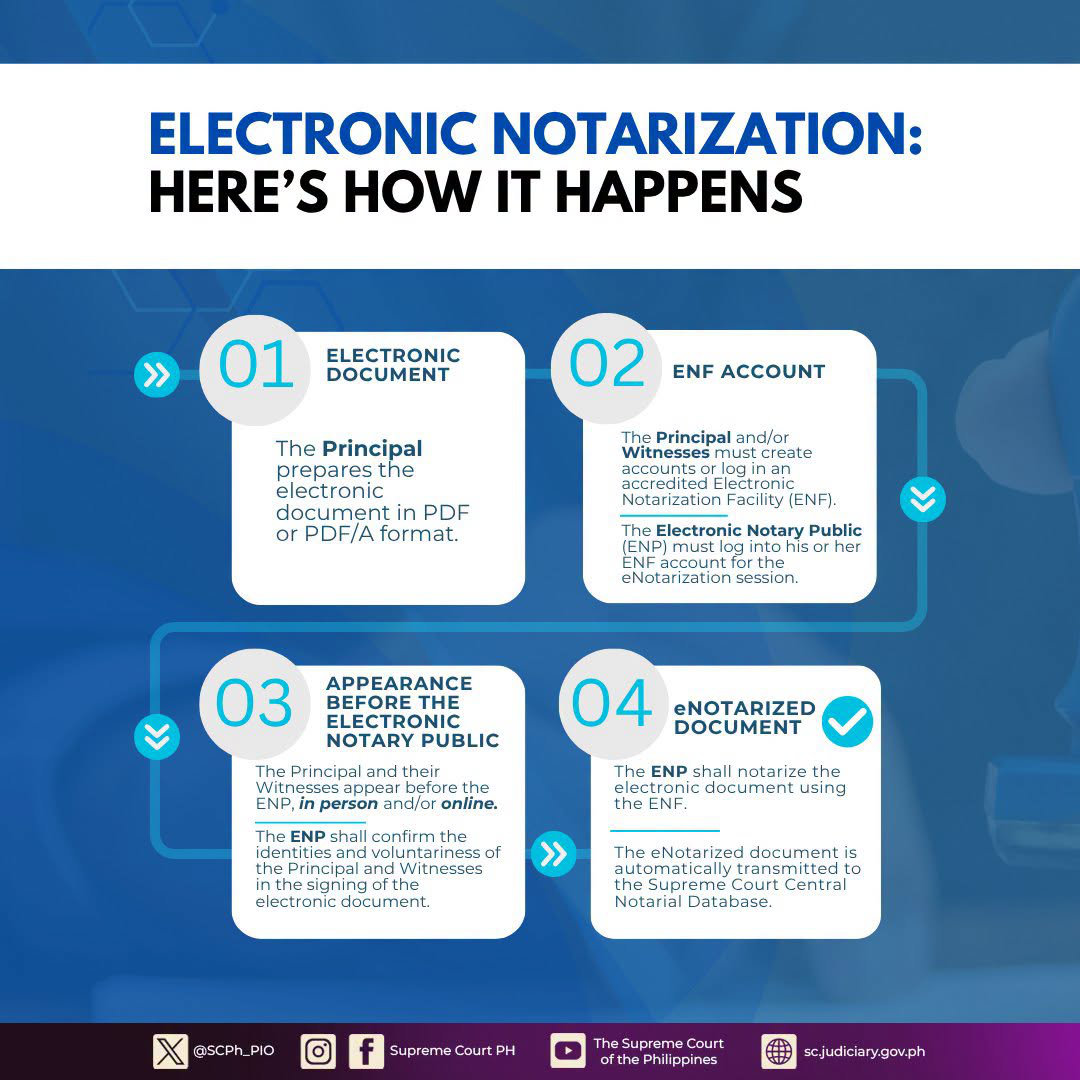
A principal begins by preparing the document in PDF or PDF/A format. The principal and any required witnesses then create accounts with an accredited electronic notarization facility, while an electronic notary public logs into the same platform to conduct the session. Depending on the mode chosen – in-person, remote, or hybrid – the parties appear before the notary, who verifies their identities and confirms that they are signing voluntarily. Once the notary completes the notarization, affixing an e-signature and e-notarial seal, the document is uploaded automatically to the Supreme Court’s Central Notarial Database.
An Office of the Electronic Notary Administrator oversees the commissioning of electronic notaries public and the accreditation of notarization facilities. The system is built around encryption and identity verification safeguards, and remote sessions are recorded on audio and video. Facilities and notaries handling personal data must also comply with the Data Privacy Act of 2012 and register with the National Privacy Commission.
What changes for Filipino document holders
Under the 2004 rules, a notary public could only notarize documents within their assigned territorial jurisdiction, which meant signatories often had to find a notary licensed in the specific city or province where the transaction was taking place. The new framework removes that restriction for electronic documents: an electronic notary public commissioned anywhere in the Philippines can notarize a document for a signatory located anywhere else in the country, and in certain cases, for Filipinos abroad.
This is not the Supreme Court’s first attempt at remote notarization. In 2020, it introduced the Interim Rules on Remote Notarization of Paper Documents as a temporary measure during the pandemic. The 2025 rules replace that stopgap with a permanent system built specifically for electronic documents rather than scanned paper ones.
The eNotarization rollout is part of the judiciary’s Strategic Plan for Judicial Innovations covering 2022 to 2027. The Supreme Court has set up an Electronic Notary Services Helpdesk for inquiries about the process. Further details on the rules and accreditation guidelines are available on the Supreme Court’s website.