



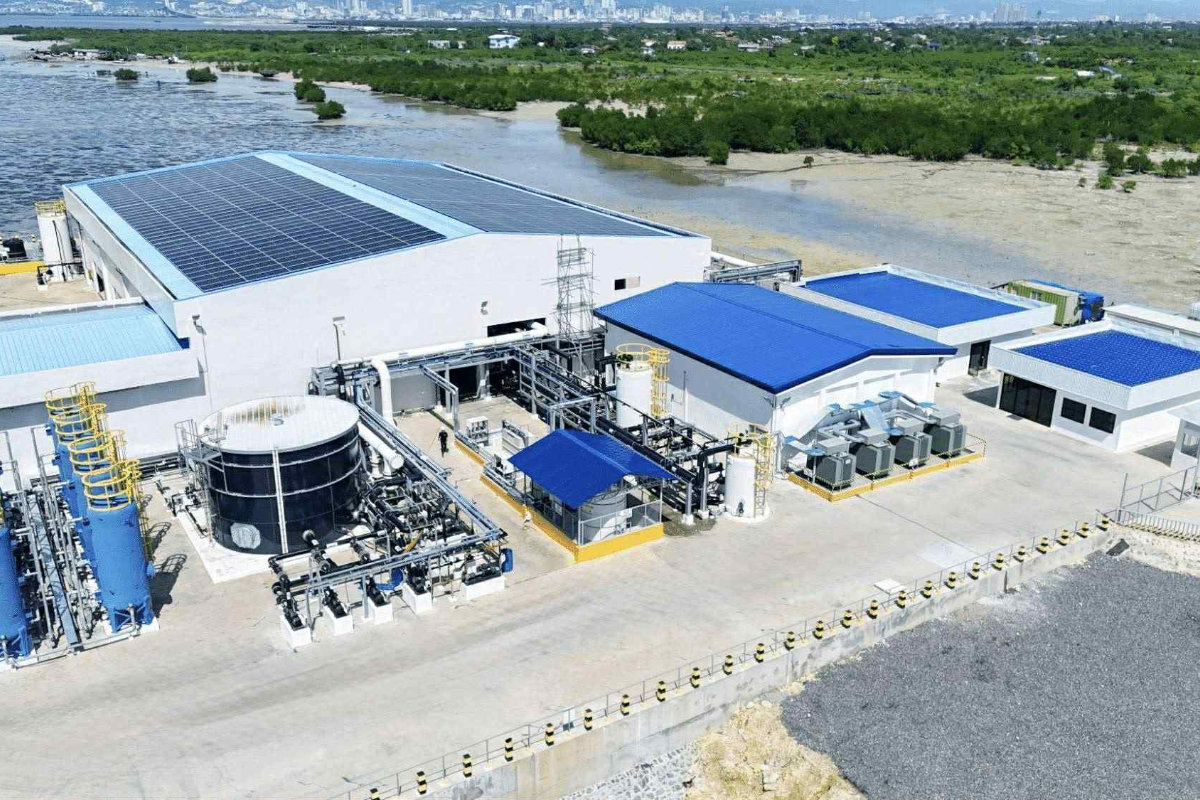
The Cordova Desalination Plant, the Philippines’ first utility-scale facility that turns seawater into drinking water, began supplying Metro Cebu’s water network on July 1. Deliveries started at 5 million liters a day, a quarter of the plant’s 20-million-liter capacity.
The shortage it is meant to ease is far larger. Vivant Water president Jess Anthony Garcia said in a September 8 interview that the Metropolitan Cebu Water District (MCWD) supplies about 250 million liters a day, while demand in Metro Cebu could already be 500 million to 600 million liters. That is a deficit of more than 200 million liters, and Cordova at full output would cover about a tenth of it. Garcia described the plant’s contribution as “Gamay ra kaayo na,” Cebuano for very small.
MCWD cited a smaller figure when deliveries began: a daily deficit of more than 16,000 cubic meters (16 million liters). Full output of 20,000 cubic meters would exceed that. It is not clear from available coverage why the two numbers differ.
The timing is tied to weather. Cebu City declared a water crisis in early 2024 during El Niño, and MCWD said the July deliveries came as weather authorities warned that El Niño could intensify.
The ₱2-billion plant is located in Cordova on Mactan Island. Isla Mactan Cordova Corp. (IMCC), a subsidiary of Vivant Water, the water arm of Cebu-based Vivant Corp., operates it. The plant uses seawater reverse osmosis, which forces seawater through membranes to remove salt, with energy recovery devices to cut power use.
Getting here took longer than planned. Vivant won the supply contract in a competitive bid in 2022. By September 2023, the machines were installed and commercial operation was expected by early 2024. The Office of the Government Corporate Counsel then rejected draft agreements for Cordova and two other Mactan projects over deficiencies. MCWD and Vivant Water signed a 25-year agreement in April 2025, and a ceremonial tapping connected the plant to MCWD’s network on July 1, 2026.
Pipes now set the pace. Garcia said the plant can run at full capacity once MCWD upgrades its distribution network. “The MCWD administration has been actively looking for partners who understand the urgency of Cebu’s water needs and share our vision of serving Cebuanos better,” said MCWD general manager John Dx Lapid.
Garcia called the plant a standby source. “It’s effectively a security plant,” he said. “It will address water security in times of scarcity and it won’t be affected by the climate.”
Cost is the trade-off. Desalination uses a lot of electricity and costs more than groundwater or surface water. “This is a long-term investment in Cebu’s water resilience,” Vivant chief executive Arlo Sarmiento said in 2025, while noting that desalination carries higher production costs.
Garcia said desalinated water could cost about ₱73 per cubic meter, which he said is below the cost of bottled or tanked water. MCWD’s separate 10-year deal with Manila Water Philippine Ventures was priced at ₱58 per cubic meter for the first five years. Neither figure is a confirmed price MCWD pays Vivant, and available coverage does not say how costs would reach household bills.
Vivant plans ₱7 billion in capital spending this year on its water unit, covering desalination, wastewater and distribution. The plant’s output can be increased to 50 million liters per day. When fully operational, the plant is expected to serve nearly 30,000 households.