




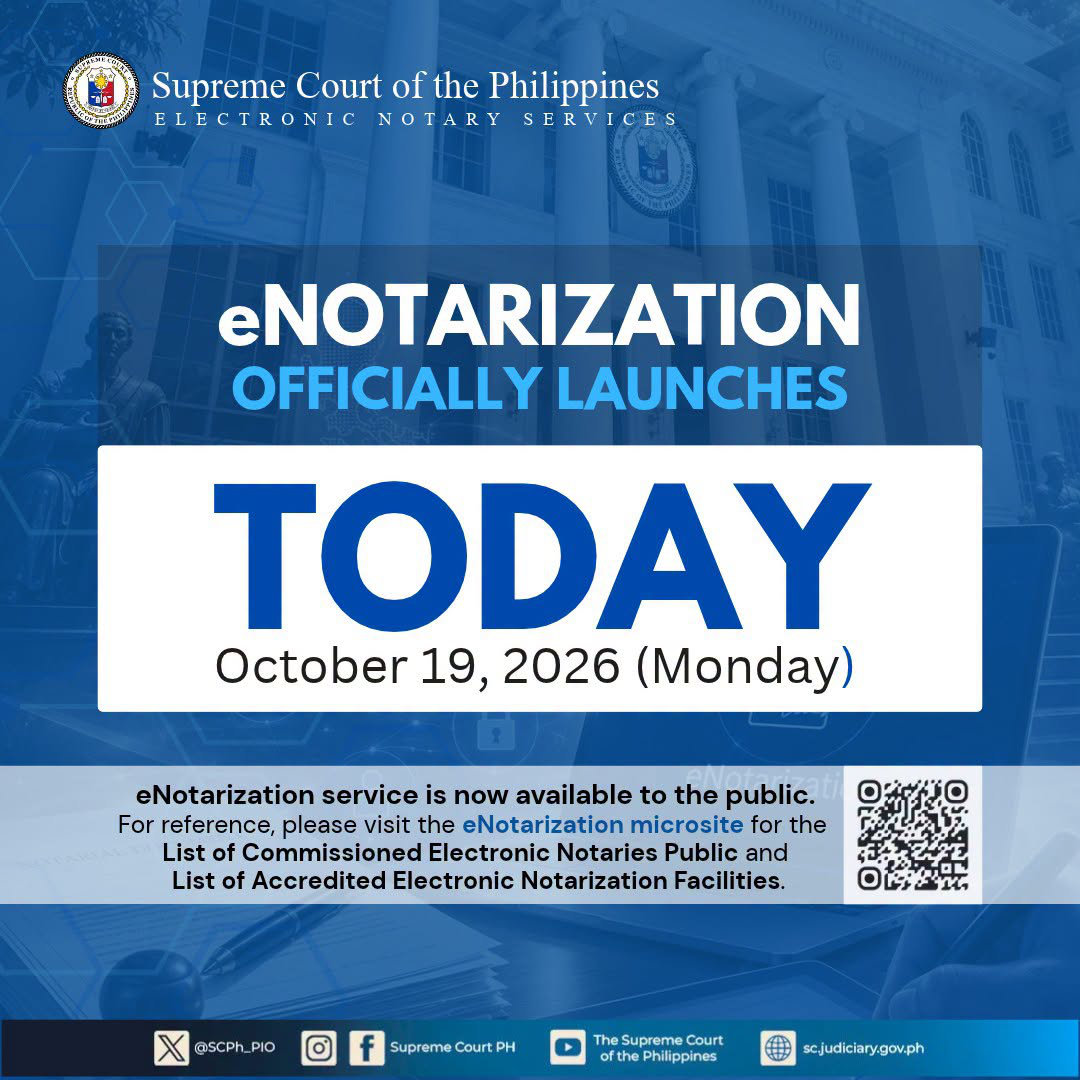
The Supreme Court of the Philippines began offering electronic notarization to the public on Monday, October 19, 2026. Digital documents can now be notarized online through accredited platforms.
In its announcement, the Court said the eNotarization service is now available. It directed the public to its eNotarization microsite for the lists of commissioned Electronic Notaries Public (ENPs) and accredited Electronic Notarization Facilities (ENFs).
What changes for Filipinos
Traditional notarization is limited to a notary public’s territorial jurisdiction. Under the 2025 Rules on Electronic Notarization, PDF or PDF/A documents can be notarized online or in person with a notary located anywhere in the Philippines.
How to avail of the service
Users must first register with one of the first batch of accredited facilities: Twala, QLegal or NotarizeIT. The registration portals are listed on the Supreme Court website. After registering, users choose an ENP from the Court’s list of commissioned ENPs. Instructional videos on using the facilities are also posted on the site.
Under the rules, the principal and any required witnesses create accounts on the chosen facility, and the ENP logs in to the same platform. The parties may appear before the ENP in person, by videoconference or through a combination of both. Once the ENP completes the notarization, the document is automatically sent to the Supreme Court’s Central Notarial Database.
The framework includes electronic signatures and seals, identity verification, authentication and protections against unauthorized alteration.
Accredited facilities
The three providers are Twala by Ohelio, Inc., QLegal by Quanby Solutions, Inc. and NotarizeIT by UNAWA, Inc.
The rules, A.M. No. 24-10-14-SC, were promulgated on February 4, 2025. The Court first considered electronic notarization in 2020, during the pandemic, when it issued the Interim Rules on Remote Notarization of Paper Documents as a temporary measure.
Associate Justice Benjamin Caguioa said the judiciary’s push to digitalize notarization was partly prompted by the difficulties people faced in accessing government services during the pandemic. He said the Court has started discussions with the Department of Foreign Affairs to extend eNotarization to overseas Filipino workers. Details of that plan have not been announced.
Applications from lawyers seeking commissioning as ENPs opened on August 10, 2026, through the Court’s eNotarization Portal.
Questions can be sent through the Electronic Notary Services Helpdesk Form at https://tinyurl.com/mpu5tzzv.