


Do you want to start a business but don’t have the money to use as seed capital? You can apply to the DSWD Sustainable Livelihood Program (SLP) to get the much-needed capital to start up your small business.
The Sustainable Livelihood Program is one of the core anti-poverty programs administered by the Department of Social Welfare and Development (DSWD). It provides capacity-building support to poor, vulnerable, and marginalized households so they can start a microenterprise or find stable employment.
Unlike direct cash aid, SLP is structured around a set of interventions: skills training, seed capital, group formation, and job facilitation. Applicants who qualify are grouped into one of two tracks depending on whether they intend to run a business or pursue employment, and each track has its own age requirement, training component, and documentary process.
If you’re interested to learn more about SLP, its qualifications, and the application process, we’ve prepared this step-by-step guide. Take note that not all applications are accepted, and you must meet certain criteria to become eligible for the program.
Table of Contents
What is the DSWD Sustainable Livelihood Program?
SLP is a capacity-building program for identified poor, vulnerable, and marginalized households and communities. It provides interventions that help participants access and acquire the assets needed to start a business or support a livelihood, rather than simply distributing financial aid.
As of November 2025, the program had reached 235,074 beneficiaries nationwide, and DSWD has continued to push for its formal institutionalization to obtain permanent funding.
The program traces its legal basis to Republic Act 11291, the Magna Carta of the Poor, which mandates the State to promote livelihood among the poor through technical and administrative support for establishing livelihood enterprises. SLP is the DSWD program tasked with delivering that mandate.
SLP Funding Modalities
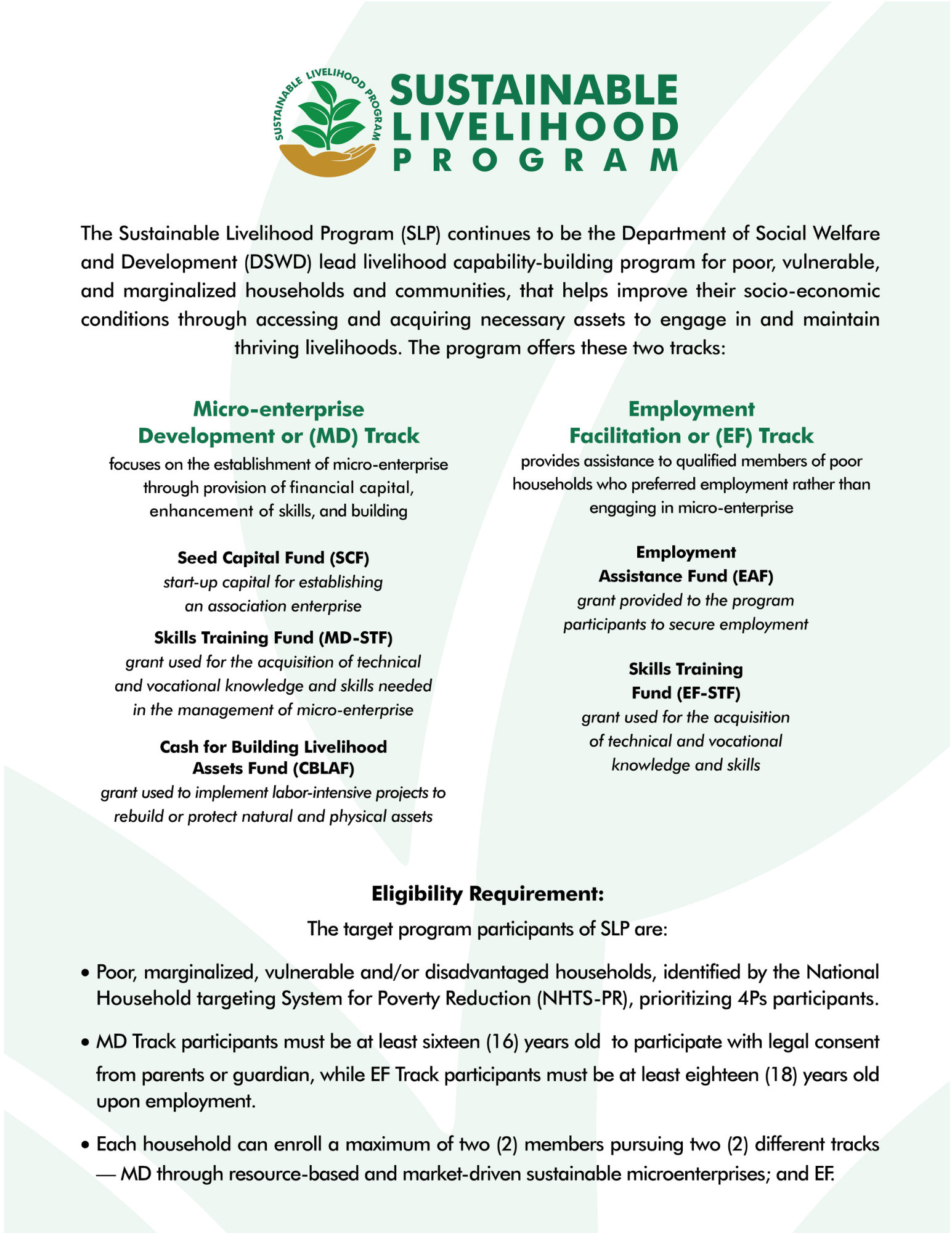
DSWD releases assistance under SLP through four modalities. Each modality funds a different stage or type of livelihood activity, and a participant’s track determines which modalities apply to their case.
- Seed Capital Fund – Start-up capital for tools, raw materials, common service facilities, and other assets needed to start or expand a microenterprise.
- Cash-for-Building-Livelihood-Assets (CBLA) Fund – Grant for labor-intensive projects that build, rebuild, or protect the natural and physical assets that a microenterprise depends on.
- Skills Training Fund – Capacity-building assistance covering the cost of technical and vocational training.
- Employment Assistance Fund – Grant that covers the cost of acquiring employment requirements, such as medical exams, NBI clearance, or transportation to a job site.
The amount released under each modality is not fixed. It depends on the applicant’s approved livelihood proposal, an assessment by DSWD, and the availability of program funds for that fiscal year and region. Reporting on the program has cited seed capital of up to ₱10,000 for microenterprises such as online selling, but this figure varies by proposal and is not guaranteed to every applicant.
The Two SLP Tracks
Every SLP participant is enrolled under one of two tracks. A single household may enroll a maximum of two members, and if both are enrolled, they must pursue two different tracks.
Microenterprise Development (MD) Track
The MD Track supports participants who want to start or grow a resource-based or market-driven microenterprise, such as a sari-sari store, food stall, farming activity, or online selling business. Participants form or join a Sustainable Livelihood Program Association (SLPA), which functions as the group through which seed capital and CBLA assistance are accessed.
To qualify for the MD Track, an applicant generally needs to:
- Be at least 16 years old, with documented parental or guardian consent if a minor,
- Be a member of an SLPA or be willing to join one,
- Present a proposed microenterprise project that DSWD assesses as feasible and has market potential, and
- Have limited or no access to formal credit facilities.
Employment Facilitation (EF) Track
The EF Track supports participants pursuing wage employment instead of self-employment. It covers technical and vocational skills training, job network services that connect participants to locally available jobs matching their skills, and assistance with the paperwork required to get hired.
To qualify for the EF Track, an applicant generally needs to:
- Be at least 18 years old, in line with legal employment age requirements,
- Be willing and able to complete Basic Employment Skills Training or present other valid proof of readiness, and
- Submit employment requirements once a job placement is identified.
SLP Eligibility Requirements
Aside from the track-specific criteria listed above, SLP has a general set of eligibility standards:
- Belong to a poor, vulnerable, or marginalized household. This is typically verified through the National Household Targeting System for Poverty Reduction (Listahanan/NHTS-PR). Priority is given to current and exiting Pantawid Pamilyang Pilipino Program (4Ps) beneficiaries.
- “No-match” applicants are not automatically disqualified. Households not listed in the current Listahanan database may still qualify through the SLP Means Test, which independently assesses socio-economic status and capacity for a sustainable livelihood activity.
- Filipino citizenship and residency. Applicants must be Filipino citizens who have resided in the Philippines for a period set by the local DSWD field office, typically at least six months prior to application.
- Willingness to participate. This covers attendance at orientation and training sessions, active engagement in the proposed livelihood activity, and compliance with program rules.
- No overlapping government assistance. Applicants who received a similar income-generating grant from another government or private program within the past three years may be disqualified, in order to avoid duplicate assistance.
Exact age brackets and residency periods can vary slightly between DSWD field offices and have been updated across different administrative issuances. Applicants should confirm the current figures with their local City or Municipal Social Welfare and Development Office (C/MSWDO) before assuming eligibility.
Documentary Requirements
For the MD Track:
- Signed Modality Application Form with complete attachments
- Ratified SLPA Constitution and By-laws (for group applications)
- Mungkahing Proyekto (project proposal), signed by the SLP Regional Director
- Proof of attendance at SLP Orientation and Microenterprise Development Training
For the EF Track:
- Signed Employment Assistance Fund/Skills Training Fund Needs Assessment
- Signed Modality Application Form with complete attachments
- EAF Fund Utilization Commitment
- Proof of attendance at SLP Orientation and Basic Employment Skills Training
Both tracks additionally require a Certificate of Eligibility issued by the SLP Regional Program Management Office, confirming that the applicant has completed the selection process.
How to Apply for the DSWD Sustainable Livelihood Program
Interested applicants can apply for the DSWD SLP by following these steps:
- Confirm eligibility. Check whether the household appears in the current Listahanan database, or has an active 4Ps enrollment. If not listed, households can still qualify through the SLP Means Test.
- Visit the local C/MSWDO. Applicants must coordinate with the SLP Project Development Officer (PDO) assigned to their city or municipality to confirm the schedule of upcoming SLP activities.
- Attend the SLP Orientation. This session, usually facilitated by the Implementing Project Development Officer, explains the program’s tracks, modalities, participant responsibilities, and selection criteria.
- Complete track-specific training. MD Track applicants attend Microenterprise Development Training, while EF Track applicants attend Basic Employment Skills Training, or present other valid proof of skills readiness.
- Submit the required documents. This includes the Modality Application Form and the Mungkahing Proyekto for MD Track applicants, or the EAF/Skills Training Fund Needs Assessment for EF Track applicants.
- Undergo assessment and validation. The SLP-PDO reviews the submitted proposal or needs assessment and validates the household’s socio-economic profile against the program criteria.
- Receive the Certificate of Eligibility and fund release, or job referral. Once approved, MD Track participants receive seed capital or CBLA assistance based on the approved proposal, while EF Track participants are matched with available job openings appropriate to their training.
Frequently Asked Questions
Who is eligible for the DSWD Sustainable Livelihood Program?
Eligibility for the DSWD Sustainable Livelihood Program is generally limited to Filipino citizens belonging to poor, vulnerable, or marginalized households, particularly those listed in the Listahanan database or enrolled in the 4Ps program. Households not listed in Listahanan database may still qualify by taking the SLP Means Test at their local DSWD office.
What is the difference between the MD Track and the EF Track?
The Microenterprise Development (MD) Track supports participants who want to start or expand a small business and provides access to seed capital, CBLA assistance, and business training through an SLP association. Meanwhile, the Employment Facilitation (EF) Track supports participants seeking wage employment and provides skills training, job matching, and assistance covering employment-related requirements.
How much financial assistance can SLP beneficiaries receive?
The amount is not fixed and depends on the applicant’s approved proposal, the modality applied for, and available program funds for that fiscal year and region. Amounts cited in program reporting, such as seed capital of up to ₱10,000 for a microenterprise, indicate the typical assistance levels instead of a guaranteed figure for every applicant.
Is SLP assistance a loan that needs to be repaid?
SLP funding under the Seed Capital Fund and CBLA Fund is usually structured as a grant – not a loan – provided that it is used for the approved livelihood purpose. Participants may be required to sign an undertaking committing to use the funds as proposed, and misuse of funds can have repayment or disqualification consequences.
Where can I apply for the DSWD Sustainable Livelihood Program?
Applications are processed through the City or Municipal Social Welfare and Development Office (C/MSWDO) covering the applicant’s residence, in coordination with the assigned SLP Project Development Officer. Regional DSWD Field Office websites also list contact details for their respective SLP units.
What happens if a household is not listed in Listahanan?
A household missing from the Listahanan database is not automatically disqualified from SLP. The SLP Means Test is an alternative eligibility route that assesses the household’s socio-economic status and capacity for a sustainable livelihood activity.
Why do some SLP applications get delayed?
Delays most commonly result from incomplete documentary requirements, such as missing signatures or attachments on the Modality Application Form. Applicants who prepare all required attachments before their scheduled SLP activity typically move through validation faster.
Can a microenterprise proposal be rejected under the MD Track?
Yes. A proposal assessed as having limited market potential or feasibility may be returned for revision. Applicants are advised to consult their assigned SLP Project Development Officer before resubmitting a revised proposal.
Can someone who already received similar government assistance still apply for SLP?
Applicants who received a similar income-generating grant from another government or private program within the past three years may be disqualified from a new round of SLP assistance during that period, in order to prevent duplicate aid for the same purpose.
Final Notes
The DSWD Sustainable Livelihood Program is an opportunity for enterprising Filipinos to start a business or build a livelihood of their own. If you have a business idea, it’s worth applying for this program; however, make sure that you meet all the eligibility criteria such as belonging to a poor or marginalized household.
If you have any questions and concerns about DSWD Sustainable Livelihood Program, please visit the official program website or email [email protected].
Disclaimer: This article is for general informational purposes only and does not constitute official DSWD guidance. Tech Pilipinas is an independent publication and is not affiliated with, endorsed by, or acting on behalf of the DSWD or any other government agency. Program details, including eligibility criteria, requirements, funding amounts, and availability, are subject to change without notice. Readers should verify current information directly with the DSWD’s official website or their local DSWD field office before applying.