



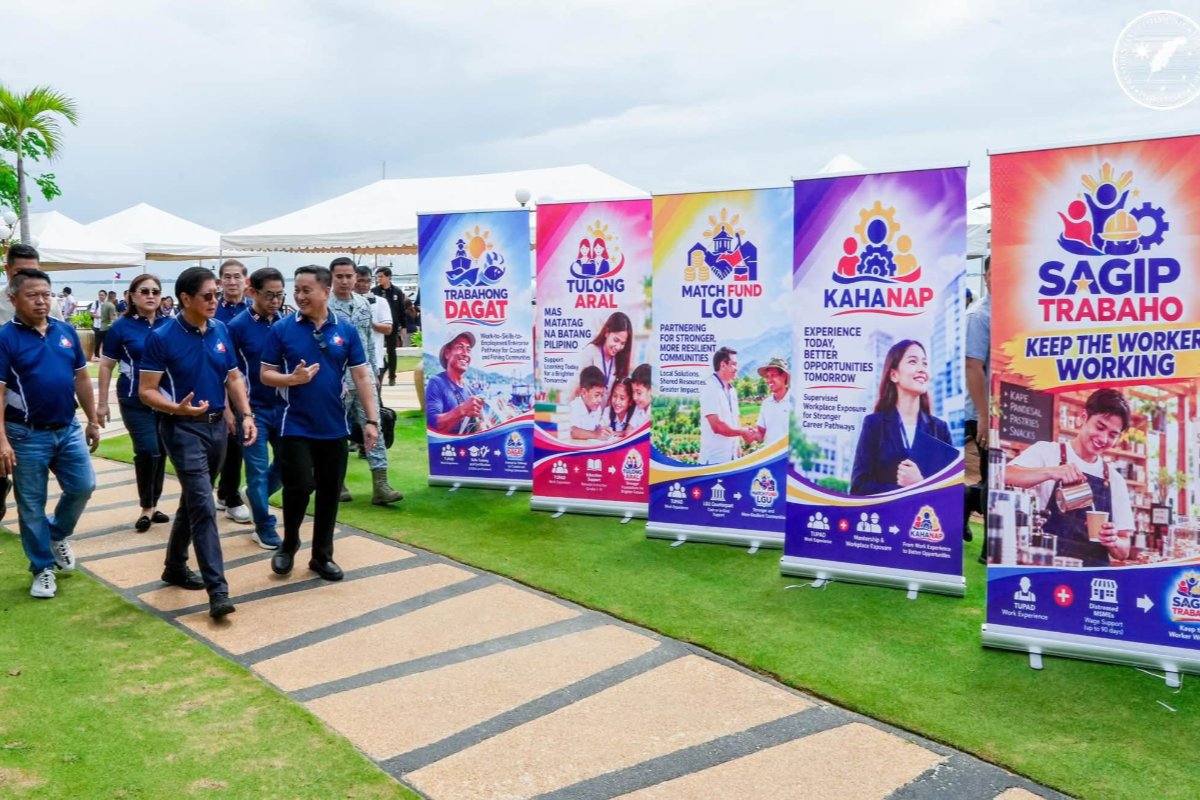
President Ferdinand Marcos Jr. introduced seven employment and livelihood programs in Lapu-Lapu City on October 14. The programs fall under the Department of Labor and Employment’s (DOLE) Tulong Panghanapbuhay sa Ating Disadvantaged/Displaced Workers (TUPAD) program and are meant to move disadvantaged workers from temporary jobs toward stable work and lasting income.
Marcos led the launch at the 26th National Public Employment Service Office (PESO) Congress, held at Jpark Island Resort & Waterpark in Barangay Maribago. Labor Secretary Francis Tolentino briefed him on the enhanced TUPAD program. The President also met at least 75 beneficiaries, many of them fisherfolk who received livelihood assistance such as fishing boats and fish pens.
The programs are SkillPass, Tropa Negosyo Trabaho, Sagip-Trabaho, KaHANAP, Match Fund LGU, Tulong-Aral and Trabahong-Dagat.
Wage subsidy for Central Visayas employers
Sagip-Trabaho provides wage subsidies of up to 90 days to qualified micro, small and medium enterprises (MSMEs) affected by mandated wage increases. Tolentino said the government will shoulder the additional ₱42 daily minimum wage for qualified MSMEs in Central Visayas.
Marcos announced that new minimum wage rates for Central Visayas took effect on Wednesday, October 14. Covered private-sector workers receive an additional ₱42 in daily pay, while domestic workers, or kasambahays, receive an additional ₱500 monthly.
“These increases aim to improve workers’ earnings and help them provide for their families,” Marcos said.
Capital, skills and work experience
Tropa Negosyo Trabaho, also called Puhunan Ko, offers capital assistance of ₱50,000 to ₱500,000 to groups of at least five qualified beneficiaries starting microenterprises. The assistance includes business training, mentoring and market support.
SkillPass lets TUPAD beneficiaries document their work experience and skills. Participants may also undergo skills assessment and certification through the Technical Education and Skills Development Authority (TESDA). Under KaHANAP, job-ready beneficiaries and other qualified workers can be placed with MSMEs for up to 90 days of supervised work experience.
Match Fund LGU pools DOLE and local government resources to expand temporary employment, particularly in fourth-, fifth- and sixth-income-class municipalities. Tulong-Aral trains education graduates and academic mentors to help Grades 1 to 3 pupils improve their reading, writing and mathematics.
Trabahong-Dagat covers employment, skills training and enterprise development for fisherfolk, coastal youth and other qualified workers, especially during closed fishing seasons. Its scope includes aquaculture, fisheries production and small-business development under the blue economy.
Skills alignment and employment figures
In his speech, Marcos cited limited access to job information and a mismatch between workers’ skills and industry needs as continuing obstacles to employment. He said the Department of Education, DOLE, the Department of Trade and Industry, the Commission on Higher Education and TESDA have been directed to align their training programs with labor market needs.
“We continue to promote skills development responsive to local and international business and industries and strengthen the link between training and employment,” Marcos said.
The government held 1,554 job fairs nationwide from January to August 2026, with 65,534 people hired on the spot, according to Marcos. More than 91 percent of qualified jobseekers under the PESO program were placed in jobs. As of August 2026, TUPAD had given emergency employment assistance to more than 14 million beneficiaries since the start of the administration.
A job fair held at Island Central Mactan in Lapu-Lapu City during the congress offered more than 1,300 vacancies, including 275 in the maritime sector.