



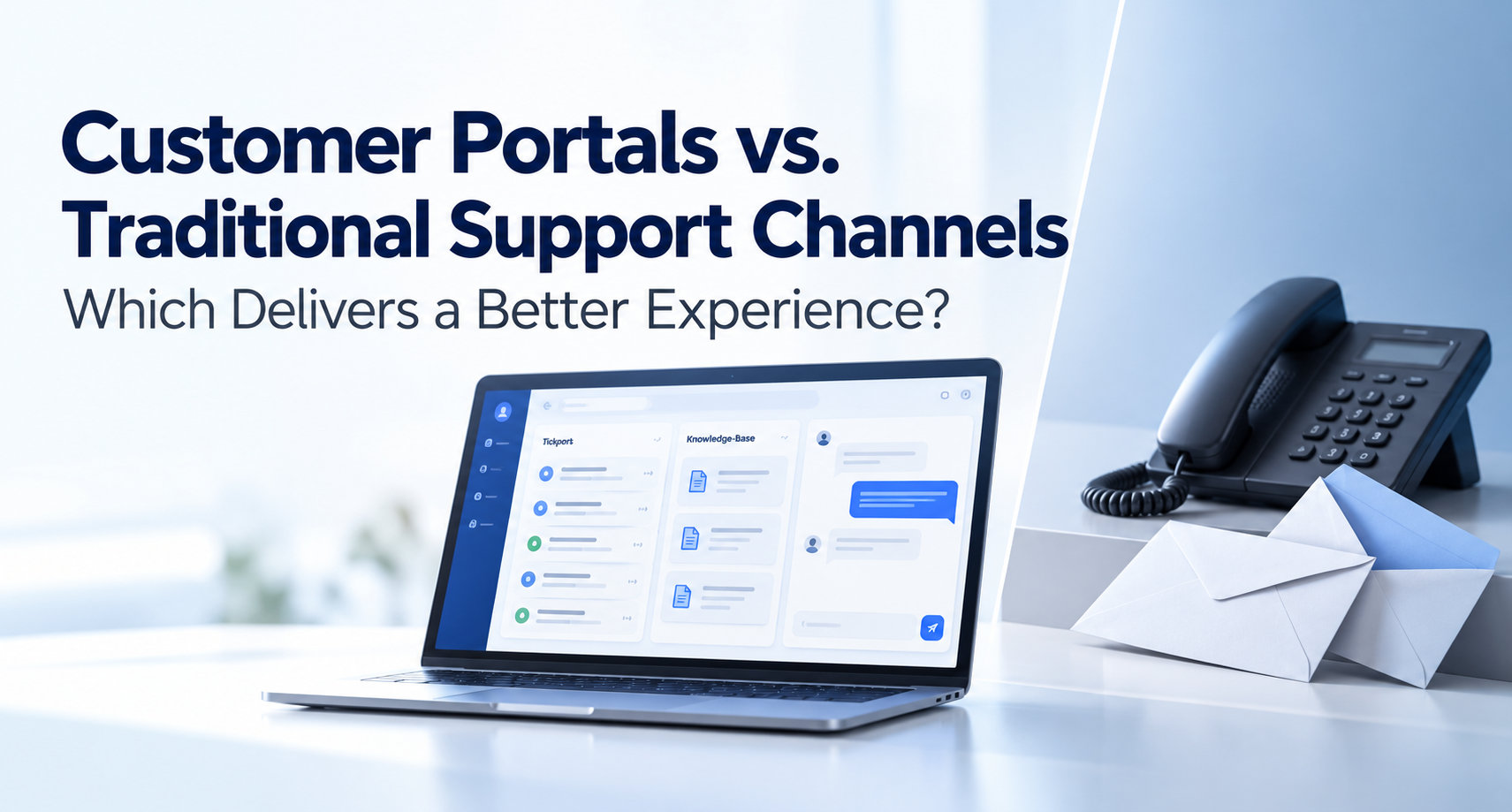
Every growing business reaches a point where its support model stops keeping pace with its customers. The phone line that worked well for 200 clients starts to strain at 2,000. Email threads pile up, answers vary depending on who picks up the ticket, and a customer who simply wants an order update waits in the same queue as someone with an urgent problem.
This is rarely just a staffing issue. More often, it is a technology issue. Businesses that invest in custom web application development services to build secure, self-service customer portals are finding that the quality of support depends less on how many agents are on shift and more on how well the underlying software is built to grow.
For decision-makers, the real question is no longer whether to offer digital support. It is whether the platform they build today is enterprise-grade enough to serve their customers, and protect their margins, five years from now.
Where Traditional Support Starts to Break Down
Phone, email, and agent-led live chat all follow the same model: one customer, one agent, one conversation at a time. That model has genuine strengths. It is personal, flexible, and well suited to complex or sensitive issues. The catch is that it scales in a straight line. Double your customers, and your support costs roughly double with them.
A second bottleneck appears when businesses try to bolt self-service onto systems that were never designed for it. A portal pieced together from generic plugins, disconnected databases, and manual back-office steps often creates more tickets than it resolves. Leaders exploring custom AI software development services are learning the same lesson: features like automated ticket routing or instant answers only perform well when the architecture underneath them is solid.
What Defines an Enterprise-Grade Customer Portal
A customer portal is more than a login page with an FAQ. An enterprise-grade portal is a complete application where customers view accounts, track requests, access documents, make payments, and solve problems on their own schedule. Five qualities separate a great portal from one that sends customers back to the phone.
Scalability
A scalable portal serves 500 users or 50,000 without slowing down or needing a rebuild. Think of it as a building designed with the foundation for extra floors, rather than one that must be torn down when the business outgrows it.
Security
Portals hold sensitive information such as invoices, contracts, and personal records. Role-based access, encryption, and regular security audits are baseline expectations, especially in regulated industries like healthcare and financial services.
Performance
Customers judge a portal in seconds. If pages load slowly or search returns nothing useful, they pick up the phone instead, and the investment loses its value.
Reliability
A self-service channel that fails during peak demand damages trust faster than having no portal at all. Consistent uptime, dependable backups, and clear error messages are what make customers comfortable relying on it.
Integration Capabilities
A portal is only as useful as the data behind it. It needs to connect with your CRM, billing, inventory, and help desk systems. When a customer sees a live delivery date instead of last week’s estimate, that is integration doing its job.
Key Pillars for Long-Term Growth
Modular Architecture: Microservices vs. Monolith
A monolithic portal is built as one large, interconnected block. It is quicker to launch but harder to change, because updating the billing screen can unexpectedly affect the ticketing feature. A microservices approach splits the portal into independent parts, such as login, payments, knowledge base, and ticketing, that can be updated or scaled separately.
Not every business needs full microservices on day one. A well-organized modular build is often the smarter starting point, with a clear path to separate services as traffic grows.
Cloud-Native Development
Cloud-native portals adjust capacity automatically. During a seasonal rush or an unexpected service outage, they scale up to absorb the surge, then scale back down when things calm. Businesses pay for the capacity they actually use rather than for servers sitting idle.
Data-Driven Decision Making
Every portal interaction leaves a useful trail. Which help articles do customers read right before raising a ticket anyway? Where do they abandon a form? Phone support captures very little of this, while a well-built portal turns everyday behavior into a roadmap for improving both the product and the service.
Automation and AI Readiness
Automation takes care of repetitive tasks like password resets, status updates, and appointment changes. AI goes further by suggesting answers, summarizing long ticket histories for agents, and spotting frustrated customers before they leave. The important word here is readiness. Clean data, open APIs, and modular design decide whether adding AI later is a simple upgrade or a costly rebuild.
Common Mistakes Businesses Make
A Short-Term Development Mindset
Many teams treat the portal as a one-time project. They launch quickly to hit a deadline, then discover that every new feature requires undoing shortcuts from the first release. A portal is a long-term product, not a box to check.
Ignoring Scalability Early
“We’ll fix it when we grow” sounds practical. In reality, rebuilding a live portal with thousands of active users costs far more, and disrupts far more, than planning for growth upfront. Planning for scale does not mean overbuilding. It means avoiding choices that box you in later.
Choosing the Wrong Tech Stack
Selecting technology because it is trending, or because one developer prefers it, often creates problems later. The right stack fits your integration needs, your security requirements, and the talent available to maintain it for years.
Best Practices for Building a Future-Ready Portal
Plan Strategically Before Development Begins
Start by mapping the customer journey. Identify the top ten reasons customers contact support today, and design the portal to resolve as many as possible without human help. Then decide which issues should still reach a person. The goal is not to replace traditional channels but to reserve them for conversations that genuinely need human judgment.
Choose the Right Development Partner
The right partner asks hard questions about your business before talking about features. Ask how they handle integrations, security compliance, and post-launch support, and look for evidence of systems they have scaled over time.
NewAgeSysIT, a custom software engineering company headquartered in New Jersey and focused primarily on the US market, approaches portal projects with this kind of architecture-first thinking. Its teams typically map existing support workflows and system dependencies before a feature list is drafted. That sequence reflects a broader industry lesson: many costly portal problems are really planning problems in disguise.
Commit to Continuous Optimization and Iteration
Launch day is the starting line. Track self-service resolution rate, ticket volume, and customer satisfaction, gather direct feedback, and release improvements in small, steady updates. Portals that evolve alongside their customers keep adoption high.
A Real-World Example: From Overloaded Phone Lines to Self-Service
Consider a composite but very common scenario: a mid-sized B2B distributor serving around 3,000 business accounts with a 12-person support team. Most calls were routine requests for order status, invoice copies, and delivery dates, and agents spent their days reading information off a screen.
Instead of hiring more staff, the company invested in a modular, cloud-native portal connected directly to its order management and shipping systems. Customers could check orders, download invoices, and see live delivery updates at any hour.
Routine calls dropped sharply, and the support team shifted its time toward complex accounts and relationship building. Because the architecture was modular, the company later added AI-assisted ticket triage without rebuilding the core platform. The portal did not replace its people. It freed them to do more valuable work.
Conclusion: So, Which Delivers a Better Experience?
Neither channel wins on its own. For speed, round-the-clock availability, and consistency at scale, a well-built customer portal outperforms traditional support. For complex, high-stakes, or emotional conversations, people still matter.
The strongest experience comes from a portal-first model backed by a capable human team. That advantage, however, only holds when the portal is built to enterprise standards. A fragile portal frustrates customers and adds workload. A scalable, secure, well-integrated one becomes a lasting competitive asset.
For decision-makers, the smartest investment is rarely the fastest build. It is the right architecture, shaped by an honest view of where the business is headed and, ideally, by experienced engineering guidance. That is what turns a support tool into a foundation for long-term growth.