



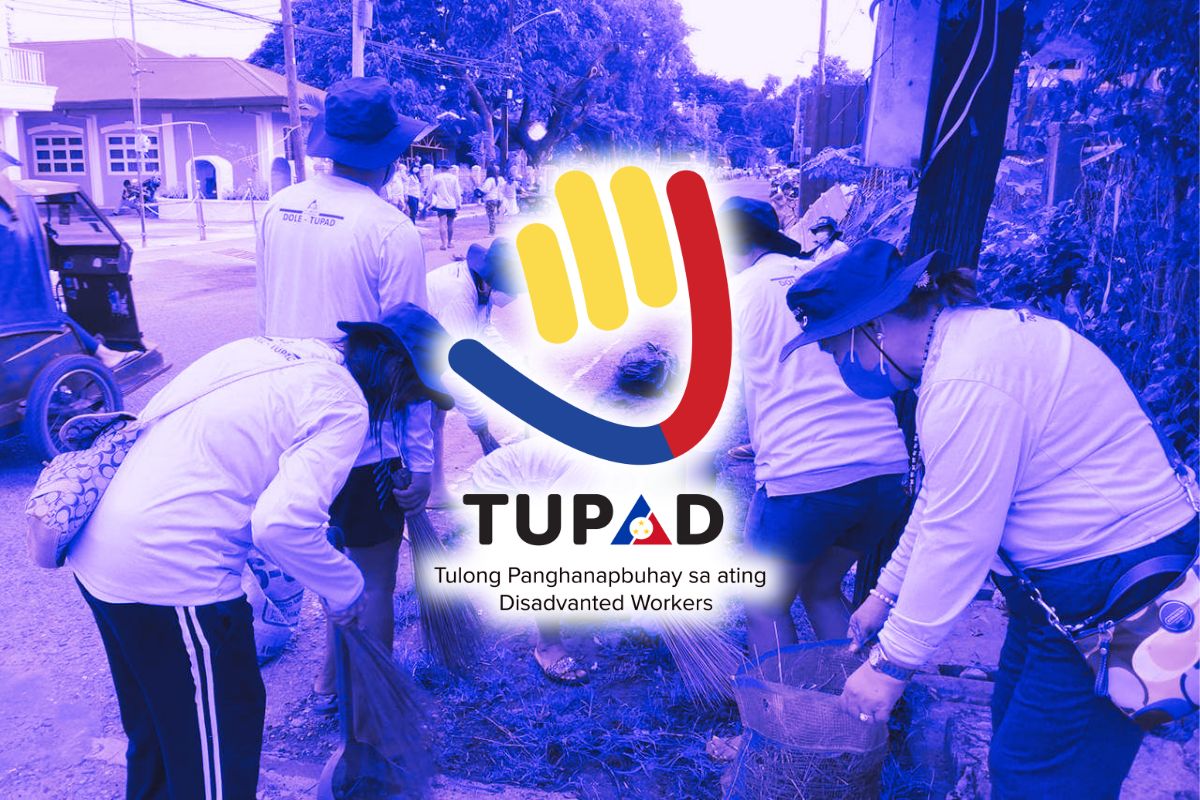
Are you looking for temporary work to earn some money? It might not sound glamorous but the Department of Labor and Employment (DOLE) has an employment program called Tulong Panghanapbuhay sa Ating Disadvantaged/Displaced Workers or TUPAD. Basically, the program allows you to engage in paid community work while you look for a more stable job or livelihood.
If you don’t mind working under the sun, the DOLE TUPAD program might be a realistic option for you. This guide explains who qualifies for TUPAD and how to apply for this short-term, cash-for-work program. Take note that there is no Internet-based online application to fill out; everything is done in person from start to finish.
Table of Contents
What is TUPAD and Who Can Apply
TUPAD is a community-based package of assistance by the Department of Labor and Employment (DOLE) that provides emergency employment for displaced, underemployed, and seasonal workers. Projects last from 10 to 30 days, with the exact length depending on the task assigned.
You’re eligible for TUPAD work if you belong to one of these groups:
- Displaced workers – Laid off, retrenched, or otherwise lost a job through no fault of your own
- Underemployed or seasonal workers – You have income, but it’s irregular or insufficient (such as farmers between planting seasons, tricycle drivers, market vendors, etc.)
- Self-employed individuals in the informal sector – Those whose income have decreased due to a calamity or economic disruption
Additionally, you must be at least 18 years old, in line with anti-child labor laws.
Those who are not qualified for TUPAD include active government employees, regardless of appointment status, and those already receiving assistance through DOLE’s CAMP program or DSWD’s AICS.
TUPAD is not a cash handout. It only funds work tied to specific community projects, which is the reason why availability depends on what your LGU has proposed and gotten approved. The categories are:
- Social community projects – Repair of schools and health centers, debris clearing, de-clogging canals, and waste segregation
- Economic community projects – Repair of farm-to-market roads, bridges, public markets, and post-harvest facilities
- Agro-forestry projects – Tree planting, seedling preparation, and reforestation
If your barangay hasn’t submitted a project proposal in any of these categories, there’s simply no TUPAD slot to apply for yet.
TUPAD Requirements
According to DOLE, the only requirement you need to apply for TUPAD is a valid government-issued ID. However, your barangay or LGU might ask for additional requirements.
Prepare the following for your TUPAD application:
- A valid government-issued ID such as UMID, voter’s ID, National ID, or driver’s license.
- Barangay certification confirming your residency and your status as displaced, underemployed, or otherwise disadvantaged.
- Certificate of residency, typically required when you’re applying through PESO.
- Certification of fitness to work, which some LGUs require before clearing you for physical community labor, particularly for senior citizens or previously retired applicants.
How to Apply for TUPAD
Method 1: Through Your Barangay (Most Common Route)
This is how the large majority of TUPAD employment slots get filled, since the barangay is the one that submits the project proposal to DOLE.
- Visit your Barangay Hall and ask the barangay secretary or the officer in charge of livelihood programs whether a TUPAD batch is open or being planned.
- Request to be added to the list of prospective TUPAD beneficiaries. Barangays usually prioritize residents who can show that they’re unemployed, underemployed, or affected by a recent calamity.
- Present a valid government-issued ID. If you don’t have one yet, ask the barangay what alternative proof of identity they’ll accept.
- Get a barangay certification. This proves your residency and confirms that you meet the “disadvantaged” or “displaced” classification that the barangay is using in its proposal.
- Wait for the barangay to submit its documentary requirements to DOLE. This includes a signed TUPAD Work Program, a Letter of Intent, and a list of beneficiaries. Your barangay is solely responsible for this; you don’t file anything with DOLE directly.
- Attend the orientation once you’re confirmed. DOLE or its accredited co-partner will schedule a basic orientation on workplace safety and health before deployment.
I recommend this method over going directly to DOLE because barangays already have direct lines to their DOLE field office, and proposals are processed quicker when they come from an LGU.
Method 2: Through the Public Employment Service Office (PESO)
If your barangay isn’t actively running a TUPAD program, your city or municipal PESO is an alternative option.
- Visit the PESO office in your city or municipal hall and inquire about current or upcoming TUPAD allocations.
- Submit a photocopy of a valid ID along with a certificate of residency.
- Get a certification of fitness to work especially if you’re a senior citizen. Some LGUs require this before you’re cleared for physical community labor.
- Wait for the notification of profiling. PESO coordinates with DOLE to schedule a profiling and orientation session for shortlisted applicants. This step can take anywhere from a few days to over a week, depending on how many other applicants are ahead of you.
- Attend profiling and sign your TUPAD contract. Once finalized, you’ll be issued a TUPAD ID and personal protective equipment before starting.
Method 3: Directly Through a DOLE Field, Provincial, or Regional Office
If your barangay or the PESO office doesn’t have TUPAD programs running or planned, your last option is the DOLE.
- Identify the DOLE Field, Provincial, or Regional Office nearest you. This is a DOLE office, distinct from your city or municipal PESO, which is run by the LGU.
- Visit in person, or send an email with your full name, address, and contact number, stating that you’re applying for TUPAD.
- Call the DOLE Hotline 1349 if you’re unsure which office to approach, or if your barangay or LGU says they’re unfamiliar with the TUPAD process. DOLE can point you or your barangay to the correct field office.
- DOLE will validate your details with your LGU. Even when you approach DOLE directly, they may still coordinate with your barangay or city government to confirm your eligibility before you’re added to a beneficiary list.
- Wait for a response. Since this route skips the usual LGU-initiated proposal, processing can take longer than going through an already-active batch in your barangay.
Consider DOLE as your last resort. Barangay and PESO applications tend to move faster because those offices already have an open project where DOLE can slot you into.
What Happens Once You’re Accepted to TUPAD
Before the actual work begins, DOLE or its partner LGU will hold a basic orientation on occupational safety and health, and you’ll be provided with a T-shirt and hat as personal protective equipment. You’ll also be enrolled in group micro-insurance and issued a TUPAD ID.
Wages are paid through a money remittance service provider, based on the prevailing minimum wage in your region, for the number of days specified in your work assignment. Where an accredited co-partner or LGU is involved, DOLE sends a representative to witness the payroll release.
Once your project is completed, you’re expected to indicate your interest in a follow-up skills training under TESDA’s Training for Work Scholarship Program, which is meant to help you transition into more stable employment instead of putting you back to TUPAD.
TUPAD in 2026: What’s Different This Year
There have been a number of significant changes in the DOLE TUPAD program since last year; worth knowing them before you head over to the barangay hall to apply.
Fewer slots overall
DOLE’s TUPAD budget was slashed from ₱18 billion in 2025 to ₱11 billion for 2026. Labor Secretary Bienvenido Laguesma has said publicly that the number of beneficiaries the program can serve this year will likely be “significantly reduced,” which means that competition for available slots is tighter than in past years.
Coverage expanded to new groups
Under Department Order 239-B, series of 2026, DOLE widened TUPAD eligibility to include guardians of DOLE-profiled child laborers and micro-entrepreneurs who have already undergone a DOLE Technical and Advisory Visit. If you belong to either category, mention it specifically when you inquire at your barangay or PESO, since not every front-line staff member may be aware of the expanded coverage.
Stricter monitoring of actual work performed
In August 2026, the Palace publicly called out reports of some TUPAD beneficiaries allegedly staging photos of canal-clearing work that they hadn’t actually performed. Local officials, including Cainta’s mayor, have since pushed back on “petiks” (slacking) applicants and emphasized that slots are meant for people genuinely willing to do the assigned work. Expect closer supervision and documentation requirements at deployment sites in the future as a result.
Frequently Asked Questions
Is there a fee to apply for TUPAD?
No. TUPAD is a fully government-funded program, and legitimate applications through your barangay or PESO will never require payment.
Can I apply for TUPAD online?
No. TUPAD runs through barangay and LGU project proposals submitted to DOLE regional offices, so there’s no centralized online application portal for individual beneficiaries.
How much does TUPAD pay?
Wages are set at the prevailing minimum wage in your region and are paid through a money remittance provider for the duration of your assigned work, which runs 10 to 30 days depending on the project.
Can government employees apply for TUPAD?
No. Active government employees, regardless of employment status, are ineligible for TUPAD, as well as anyone already receiving assistance through DOLE’s CAMP or DSWD’s AICS programs.
What if my barangay has no ongoing TUPAD project?
Check with your city or municipal PESO office, since TUPAD projects don’t run in every barangay at the same time. You can also ask your barangay when the next project proposal is planned.
I applied weeks ago and haven’t heard back. What should I do?
Processing time varies heavily by region and how busy the local DOLE field office is. If it’s been over a month without an update, follow up in person instead of waiting indefinitely.
Someone on Facebook is asking for a fee or my personal documents to process my TUPAD application. Is this legitimate?
No. DOLE and VERA Files have repeatedly flagged fake TUPAD hiring posts that lead to data-harvesting sites. Legitimate TUPAD applications don’t require payment, and DOLE doesn’t recruit through unofficial Facebook pages.
I was assigned less than 10 days of work. Is that normal?
Not typically. TUPAD’s standard duration is 10 to 30 days depending on the nature of the project, so anything shorter than that should be clarified with your barangay or the assigned accredited co-partner.
Wrapping Up
TUPAD is designed to be a short-term bridge towards more stable and permanent employment. If you found yourself out of work with a lot of time in your hands, you can give TUPAD a try. Just don’t expect it to be a regular source of income.