


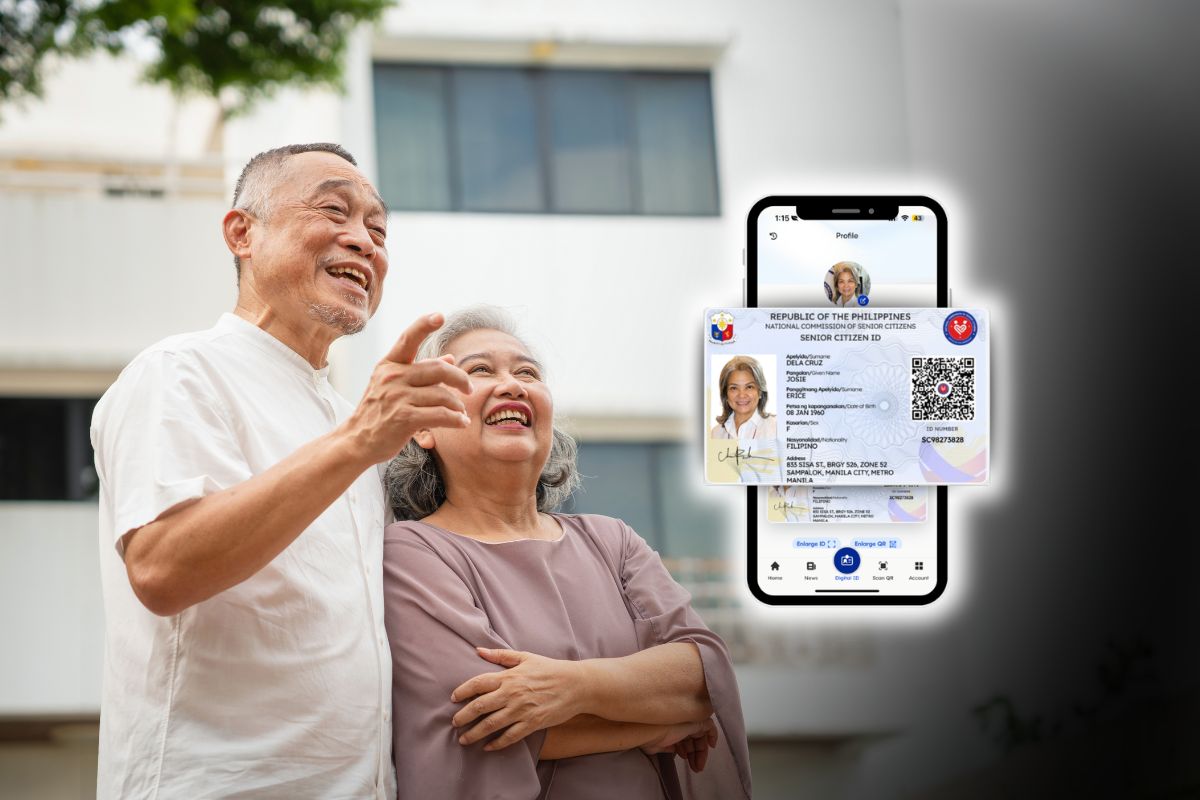
Senior citizens who hold a verified digital identification card issued through the eGovPH platform may no longer need to submit a birth certificate when applying for government cash gifts, the National Commission of Senior Citizens (NCSC) said Friday.
NCSC Chairperson Ma. Merceditas Gutierrez said that the digital senior citizen ID has already undergone verification against government databases, allowing the commission to accept it as sufficient proof of identity and age for qualified beneficiaries.
“Kapag nagkaroon na ng ID from the eGov.ph kasi dumaan na iyan sa PSA – iyon na, hindi na kami hihingi ng birth certificate pa,” Gutierrez said during the Bagong Pilipinas Ngayon briefing. (“Once they have an ID from eGov.ph, since it has already gone through the PSA, we will no longer ask for a birth certificate.”)
Gutierrez said the arrangement was developed through interagency coordination among the NCSC, the Philippine Statistics Authority (PSA), and the Cybercrime Investigation and Coordinating Center.
The development addresses one of the most common obstacles in claiming government cash gifts under the Expanded Centenarians Act: producing a birth certificate. Many elderly Filipinos, particularly those born decades ago in areas with incomplete civil registry records, have struggled to secure this document. By allowing a PSA-verified digital ID from eGovPH to stand in its place, the NCSC aims to remove a barrier that has repeatedly delayed or blocked otherwise eligible applicants.
Gutierrez said that the NCSC and local Offices for Senior Citizens Affairs (OSCAs) continue to work with the PSA to assist applicants whose civil registry documents are incomplete or unavailable. Alternative documents may also be considered to establish an applicant’s age when a birth certificate cannot be produced immediately.
“Kung mayroon namang mga dokumento, mga ibang dokumento na puwedeng mapagkilanlan… we resolve it in favor of the senior citizen applying for this,” she said. (“If there are other documents that can establish their identities… we resolve it in favor of the senior citizen applying for this.”)
Under the current process, applications are first filed with OSCAs, which forward the documents to NCSC regional offices for validation. This includes checks for duplicate applications and confirmation that beneficiaries remain eligible under program guidelines.
The NCSC has not indicated a specific date by which the revised requirement will take full effect nationwide, or whether additional guidelines will be issued to OSCAs and PSA offices to standardize acceptance of the digital ID in place of the birth certificate.
Read this article to learn how to get a Digital Senior Citizen ID.